



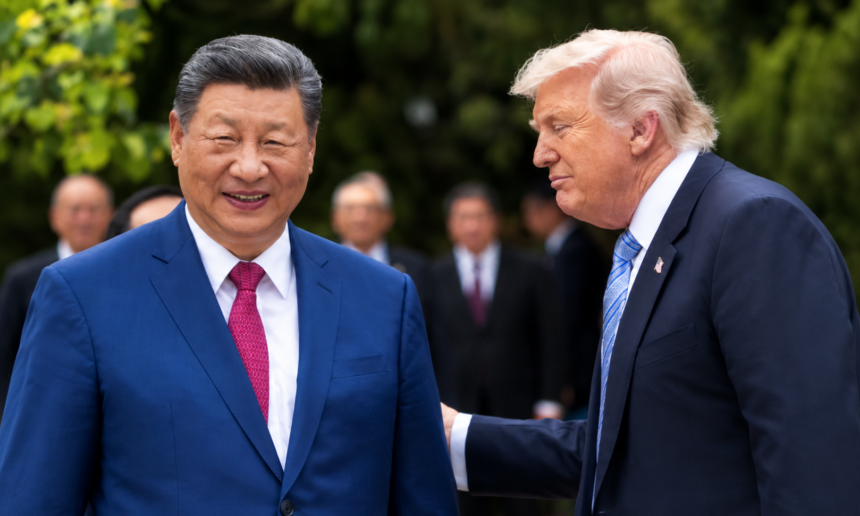
Trade, AI, Iran, and Taiwan set to dominate talks as Xi makes his first US visit in over a decade
Donald Trump and Xi Jinping are sitting down in Washington on Thursday for their third face-to-face meeting in less than a year — and this time, the guest list alone tells you how much is riding on it.
China’s president touched down at Joint Base Andrews on Wednesday evening to a welcome most visiting leaders never get: Trump and First Lady Melania Trump greeted him and his wife, Peng Liyuan, personally on the tarmac, rolling out a red carpet reception. It’s the first time in six decades a sitting US president has shown up in person to receive a guest at the base. Xi arrived with two of his most trusted figures in tow — senior aide Cai Qi and Foreign Minister Wang Yi — according to Chinese state broadcaster CCTV.
The White House has already billed Thursday’s talks as a turning point in the relationship between the two countries. But underneath the ceremony, this is Xi’s first state visit to the US in more than ten years, and the list of unresolved tensions hasn’t gotten any shorter — from the fallout of Trump’s tariffs, to the US-Israel campaign against Iran, to the long-simmering standoff over Taiwan.
Inside Xi’s Washington itinerary
The schedule reads like a carefully choreographed diplomatic performance. After Wednesday’s arrival, Thursday morning brings the main event: a formal White House welcome complete with a military flyover and close to 500 service members standing by. The two leaders will hold their talks through the day, followed by a state dinner that’s expected to draw some of the biggest names in tech and business — Apple’s Tim Cook, Nvidia’s Jensen Huang, and OpenAI’s Sam Altman among them.
Friday winds things down more quietly, with the two couples sharing tea before a visit to the National Archives to close out the trip. One notable absence from the plan: there’s no joint press conference or joint statement lined up. Instead, both governments are expected to put out separate readouts — each shaped for its own domestic audience rather than a shared narrative.
What’s actually on the table?
Trade tops the list, and there’s already been movement before the two leaders even sat down. The trade truce the two sides struck was due to lapse in November, but it’s now been pushed to January 10 — buying negotiators more runway to work toward something more permanent.
Iran is expected to come up too, given China’s longstanding ties with Tehran. Whether that translates into any real shift on the US-Israel conflict is far from certain — Trump has publicly insisted he doesn’t need Beijing’s help resolving it, even as some observers suggest Washington is quietly hoping otherwise.
Artificial intelligence is emerging as its own flashpoint. The two countries are racing each other on AI development while simultaneously worried about where that race could lead — the US has floated a new mechanism that would have both sides notify each other of any AI-related incident serious enough to pose a national security risk.
Taiwan remains the issue neither side can avoid. Washington approved an $11 billion arms package to Taiwan back in December — the largest in history — and a second, roughly $14 billion package has been sitting on hold for months. Trump himself has called the arms sales a useful bargaining chip, which tells you plenty about how he’s likely to use the issue at the table.
There’s also a quieter, more personal thread to the talks: Trump is expected to push for the release of Americans and other foreign nationals still detained in China, building on the release of Pastor Ezra Jin earlier this year — a case Trump had personally raised with Xi back in May.
A relationship built on calculated warmth
The optics of Wednesday’s welcome weren’t accidental. Melania Trump, speaking to Fox News, said her husband wanted to greet Xi personally because the two leaders “have a great relationship,” adding that hosting Xi “on our soil” called for the highest level of respect.
But warmth on the tarmac doesn’t erase what’s happened over the past two years. The relationship has been shaped almost entirely by a trade war that kicked off shortly after Trump began his second term in January 2025. The US slapped a 10% duty on Chinese goods, citing fentanyl and immigration concerns; China hit back with tariffs on American coal, LNG, crude oil, and autos, along with export restrictions on rare-earth metals critical to defense manufacturing and clean energy.
Things escalated fast — tariffs climbed into triple digits, Beijing warned its citizens against travel to the US, and additional rare-earth export curbs were threatened. A truce brokered in South Korea in October 2025 pulled things back from the brink, and when Trump visited China in May, both sides announced a new Board of Trade and Investment, with Xi agreeing to purchases of Boeing aircraft and US farm goods.
That calm didn’t last long. Trump has since imposed fresh 12.5% tariffs on goods from 60 trading partners, China included, tied to allegations of forced-labor practices in supply chains — a reminder that even a functioning truce hasn’t meant a functioning peace.
Why this meeting carries weight?
This is the third time Trump and Xi have met in person in under a year, and it comes at a moment both sides seem determined to avoid outright escalation, even while testing each other’s limits. During this visit, the two governments agreed to frame their relationship around what’s being called “constructive strategic stability” — diplomatic language for a fragile but functioning balance.
Whether that balance holds is really what Thursday’s meeting is about. The realistic outcomes aren’t a grand bargain — they’re narrower: possible tariff relief in specific sectors, cooperation on curbing drug trafficking, and an expanded military-to-military dialogue to reduce the risk of miscalculation.
If it works, it could set a steadier tone for US-China relations going forward. If it doesn’t, the same fault lines — trade, Taiwan, technology — will simply resurface at the next meeting.
Quick Facts: Trump-Xi Summit
| Detail | Information |
|---|---|
| Location | Washington, D.C. (White House) |
| Dates | Wednesday arrival, Thursday main talks, Friday departure |
| Meeting number | 3rd in-person meeting in under a year |
| Trade truce status | Extended to January 10 |
| Key agenda items | Trade, AI, Iran war, Taiwan |
| Taiwan arms package pending | ~$14 billion (second package) |
| Diplomatic framework | “Constructive strategic stability” |
| Joint statement | None planned; separate national announcements expected |
FAQ
What is the Trump-Xi summit about?
- The summit covers trade tensions, AI safety cooperation, the US-Israel war on Iran, and the Taiwan arms sales dispute — the major flashpoints in the US-China relationship.
Is this Xi Jinping’s first US visit?
- It’s Xi’s first state visit to the US in more than a decade, and his third in-person meeting with Trump in under a year.
What happened to the US-China trade truce?
- The truce, originally set to expire in November, has been extended to January 10 to give negotiators more time for a broader deal.
Will Trump and Xi hold a joint press conference?
- No. Instead of a joint statement, both countries are expected to issue separate announcements tailored to their own domestic audiences.
Why does Taiwan keep coming up in these talks?
- A $14 billion arms sale to Taiwan has been on hold for months, and Trump has described such sales as a “negotiating chip” in broader talks with China.