


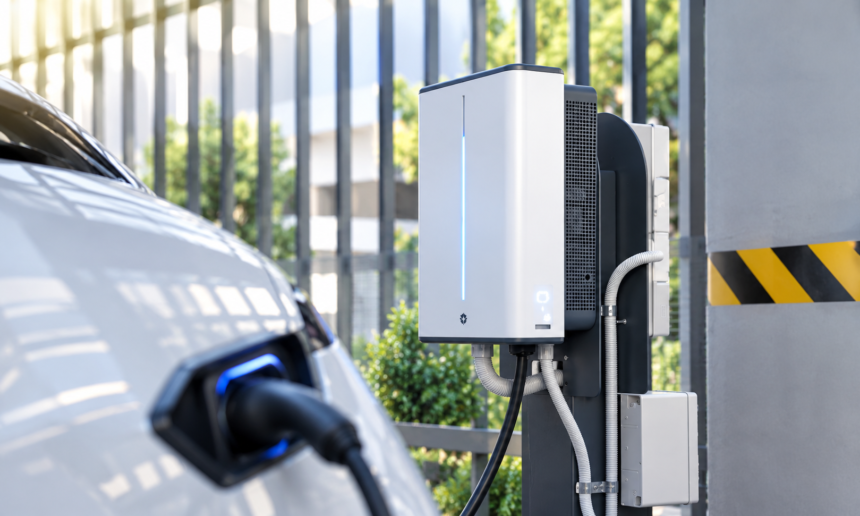
Vehicle-to-grid (V2G) technology lets electric vehicles send stored battery power back to the grid. A new peer-reviewed study suggests that the “hybrid” algorithms often used to schedule this process are not necessarily better than a simpler, well-tuned alternative.
Mixing two algorithms together does not automatically produce a better one. That is the central finding of research published in the journal Processes, where researchers tested seven optimisation methods for scheduling EV charging and discharging. The winner was not a hybrid. It was a single algorithm that adjusts its own search behaviour as it works.
The finding lands at an awkward time for a smart charging market that increasingly sells “AI” and multi-algorithm optimisation as a selling point.
Key Takeaways
- Seven algorithms tested, each run through 100 simulation trials.
- Adaptive Particle Swarm Optimization (APSO) came out on top, improving on standard PSO by 8% and on a PSO-WOA hybrid by 9.7%.
- The hybrid performed no better than plain PSO once statistical tests were applied.
- APSO also produced a flatter peak load profile across the simulated charging facility.
- The study is methodological, not a finished blueprint. It leaves out battery degradation and charging losses.
Who Ran the Study, and How?
The research team came from the University of Engineering & Technology Lahore, the University of Management and Technology Lahore, the University of Johannesburg and the University of Botswana.
They built a simulated smart parking facility. Electric vehicles arrive and leave at different times, each with its own battery capacity and a charge level the driver wants by departure. Electricity is priced on a time-of-use basis, with peak, mid-peak and off-peak periods. The algorithms had to decide when each car should charge or feed power back, at the lowest cost.
What Is the Difference Between PSO, WOA and APSO?
Both Particle Swarm Optimization (PSO) and the Whale Optimization Algorithm (WOA) are metaheuristics. Rather than solving a problem exactly, they search for a near-optimal answer by imitating a natural process.
- PSO works like a swarm. Candidate solutions move through the search space, pulled by their own best position and by the best position the whole swarm has found.
- WOA copies the bubble-net hunting of humpback whales, switching between encircling and spiralling moves to close in on a solution.
- APSO is a refined PSO. It keeps adjusting its own settings, tightening or loosening its search depending on how bunched up or spread out the candidate solutions are at each step. A standard PSO follows one fixed pattern throughout.
The Hybrid Didn’t Deliver
A PSO-WOA hybrid blends parts of both algorithms, hoping to capture the strengths of each. On paper that sounds sensible. In the tests, it did not hold up.
Once the results were checked statistically, the hybrid performed no better than plain PSO. A separately enhanced version of WOA could not be shown to beat standard WOA either. Of all seven algorithms, only APSO’s advantage survived the full battery of tests.
The researchers’ conclusion is specific. For this type of scheduling problem, the edge comes from APSO’s adaptive control of its internal search parameters, not from the act of combining two algorithms.
Why the Statistics Matter?
The team did not rely on averages alone. They ran parametric tests (t-tests and ANOVA), non-parametric tests (Mann-Whitney U, Wilcoxon Signed-Rank and Friedman), and post-hoc corrections (Holm’s Step-Down, Bonferroni-Dunn and Nemenyi). The goal was to separate real improvements from results that could plausibly be chance.
The paper argues this level of checking is uncommon in V2G scheduling research. Many earlier studies report better performance without testing whether the gains are genuine.
What This Means for the Smart Charging Market?
The study is directly relevant to any vendor that markets “hybrid” or multi-algorithm optimisation as inherently superior to one well-tuned method. It does not say hybrids can never work. It says that, in this test, hybridisation alone was not the source of better results.
The commercial pressure is real. According to EV Infrastructure News, Geely recently launched an AI-powered fast-charging system called Xingrui PowerMind, built with Chinese AI company StepFun. The company says it predicts battery temperature up to 30 seconds ahead and adjusts charging power accordingly. Geely claims a 20% improvement in battery lifecycle when it is paired with its pulse-restoration technology. Those figures come from the manufacturer’s own testing, not independent statistical validation.
Meanwhile, more automakers are committing to V2G. In August 2026, Hyundai Motor Group and energy platform Kaluza announced a partnership to build smart charging into the Kia and Hyundai apps, starting in the UK and Australia, with V2G services planned from 2027. Kaluza CEO Stephen Fitzpatrick described it as laying the technical foundation for how EVs connect with the wider energy system. How well that works will depend on how the scheduling software handles real driver preferences and live grid prices, exactly the question the Processes authors say needs independent testing.
What Rigorous Evidence Looks Like?
One of the clearer examples of validated smart charging is not a vendor claim. It is a randomised controlled trial. The Centre for Net Zero, a research institute founded by Octopus Energy, ran a 12-month trial across more than 13,000 UK households. It found that AI-managed charging cut peak household electricity use by 42% and reduced annual bills by £650 (about US$887). More than half of participating households never manually overrode the automated system.
The design used a control group tested against four treatment groups, tracked over a full year with high-frequency smart meter data. The Processes researchers would likely see that as the kind of evidence base the algorithmic V2G field still lacks.
Limitations of the Study
The paper has its own gaps, which the authors acknowledge:
- Battery degradation costs and charging-efficiency losses are left out of the model.
- The whole parking facility is treated as a single grid connection point, with no feeder- or transformer-level constraints.
- Including these factors would likely give more conservative cost estimates.
So the study should be read as a method for testing competing algorithms fairly, not as proof that any one algorithm is ready for large-scale deployment.
FAQs
What is vehicle-to-grid (V2G) technology?
- V2G lets electric vehicles send stored battery power back to the electricity grid, rather than only drawing power from it. Scheduling software decides when cars should charge or discharge.
What did the study find about hybrid V2G algorithms?
- A PSO-WOA hybrid performed no better than plain PSO once tested statistically. Only APSO showed an advantage that held up across all the statistical tests.
Which algorithm performed best?
- Adaptive Particle Swarm Optimization (APSO). It improved on standard PSO by 8% and on the PSO-WOA hybrid by 9.7%, and produced a flatter peak load profile.
Does this mean hybrid algorithms never work?
- No. The study shows that hybridising two algorithms did not automatically improve results for this scheduling problem. Other problems may behave differently.
Can this study be used to pick software for real charging networks?
- Not directly. It used a simulated facility and left out battery degradation and grid-level constraints. Its main value is showing how to test algorithms rigorously.