



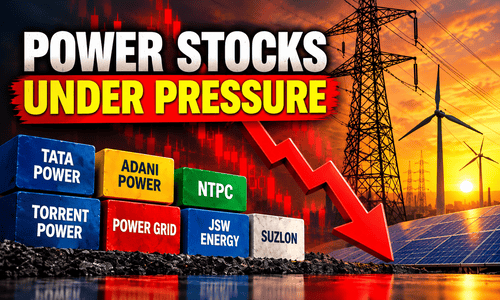
Power Stocks Slip Despite ₹1.86 Lakh Crore PM-DHARA Scheme: What It Means for Tata Power, Adani Power, NTPC, Power Grid
Shares of major power companies traded lower on Thursday, even though the government had cleared a ₹1.86 lakh crore plan a day earlier to strengthen the country’s transmission network and bring more renewable energy onto the grid. The split between a strong policy signal and a weak market reaction shows how investors often weigh long-term infrastructure spending against near-term sentiment.
How Power Stocks Moved on Thursday?
Tata Power fell 1.7% to ₹353.95, and Torrent Power declined 1.7% to ₹1,224. Adani Power slipped 1.6% to ₹200.55, while Power Grid lost 1.4% to ₹256.85. NTPC was down 1.1% at ₹318.25.
Other names in the sector were also lower. JSW Energy declined 0.8% and Suzlon Energy fell 0.7%. Vedanta Power was down 1.3% at ₹32.44.
The declines were modest and broad-based rather than sharp, and the figures reflect trading during the session, not closing prices.
What the PM-DHARA Scheme Covers?
The Union Cabinet, chaired by Prime Minister Narendra Modi, approved the scheme on Wednesday. PM-DHARA stands for PM-Developing Harmonized and Accelerated Renewable-energy Access. According to the official statement, it is meant to strengthen intra-state transmission and add 50 GWh of battery storage, so that states can evacuate up to 135 GW of renewable power.
The scheme supports India’s target of 500 GW of renewable energy capacity by 2030. Its core idea is simple: generating clean power is not enough unless the grid can carry it to where it is needed.
The financial structure is as follows:
- Total outlay: ₹1,86,405 crore, targeted for completion by FY 2032-33.
- Intra-State Transmission Systems (InSTS): ₹1,36,378 crore, under GEC-III.
- Battery Energy Storage Systems (BESS): ₹50,000 crore for 50 GWh of capacity.
- Central Financial Support: ₹54,082 crore in total.
Why Battery Storage Matters?
Solar and wind output rises and falls with sunlight and wind conditions. Battery systems can store surplus electricity when generation is high and release it when generation drops, which makes the grid more flexible and reliable and allows it to absorb more renewable power.
For companies across the power value chain, the scheme could translate into steady demand over the coming years for transmission equipment, transformers, substations and energy-storage systems. That is a multi-year pipeline, and it does not necessarily show up in share prices on the day of an announcement.
Jefferies: Demand Is Strong, Supply Is Tight
Separately, brokerage Jefferies remains positive on the sector and has named Adani Energy Solutions, JSW Energy and NTPC as its top picks. It points to a sharp pickup in electricity demand alongside tighter coal availability.
The key data points cited by the brokerage:
- Demand: Month-to-date demand is up 15% year-on-year, and FY27 demand growth has reached 10%, against Jefferies’ earlier full-year estimate of 7%. Part of the rise is linked to higher cooling demand after below-average rainfall in Q2.
- Government action: The Ministry of Power has directed 112 captive thermal power plants to run at full capacity between October 1 and December 31, 2026, using emergency powers under Section 11.
- Coal stocks: Thermal plants hold about seven days of coal, and over 40% have less than 25% of their required inventory. The Ministry is considering compulsory blending of imported coal.
- Prices: Merchant power prices have doubled year-on-year so far in September 2026. Q2 FY27-to-date merchant prices averaged ₹5.7 per unit, up 46% year-on-year and 12% quarter-on-quarter.
Jefferies expects utilities to maintain their FY26-29E earnings trajectory on execution-led growth. It highlighted JSW Energy and NTPC, and cited Adani Energy Solutions’ visible medium-term EBITDA growth of more than 20%.
What to Watch?
Investors will likely track how quickly states move to implement the transmission projects, how the coal supply situation develops through the winter, and whether merchant power prices stay elevated. The scheme’s benefits are spread over years, while stock prices respond daily to sentiment and flows.
Disclaimer: The views and recommendations cited here are those of individual analysts or brokerages, not of Vedax Digital. This article is for information only and is not investment advice. Readers should consult a certified financial adviser before making investment decisions.