


Villagers Protest as Rising Waters Swamp Homes and Temples Under India’s $87 Billion River-Linking Project
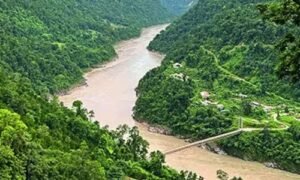
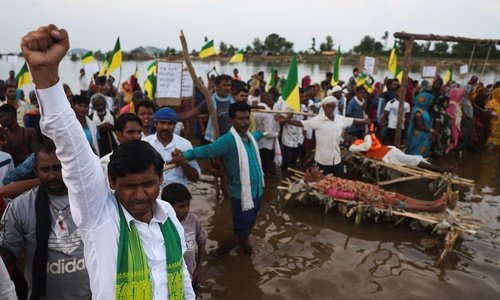
Standing knee-deep in the Ken River, her face smeared with mud, Bitti Bai Kondar made a point that needed no speech. The mud, she said through her actions, stood for the land her family has farmed for more than a century.
Kondar is one of hundreds of tribal residents in Madhya Pradesh who are angry over India’s $87 billion plan to link its rivers. She is a mother of four adult sons, and all of them are protesting alongside her. In Ajaygarh, she has watched rising water linked to work on the project flood her village. The protesters say they would rather die than leave their ancestral homes without fairer compensation.
“Our land and water, but no place to live”
Kondar’s complaint is direct. The government, she said, is taking land and water without offering another place to live. Digging for the dam, she added, is going on while the money offered is not enough to rebuild their lives.
Scores of women have turned that frustration into a striking form of protest. They have lain down on mock funeral pyres, a sign of how far some residents are prepared to go.
An early test for a decades-old idea
The dispute matters well beyond one riverbank. India’s plan to link around 30 rivers across the country has been decades in the making, but it has only gathered real momentum in recent years, with Prime Minister Narendra Modi as its main champion.
The goal is to move water to drought-prone regions and strengthen food security, particularly for tens of millions of farmers, in a country where agriculture is still a major source of employment. Critics counter that the programme could uproot communities and damage fragile ecosystems.
Phase one connects the Ken River in Madhya Pradesh to the Betwa River in Uttar Pradesh. It carries a price tag of about $4.6 billion, which makes what is happening in Panna district an early test of the larger vision.
What the government has offered?
Authorities have offered residents along the Ken River in Panna district at least 1.25 million Indian rupees (about $13,000) per hectare. That is more than double the initial offer of 500,000 rupees.
Usha Parmar, the district administrator, said more than 90% of people have already received their compensation. Some residents see it differently, arguing that the payments do not cover everything they have lost.
A submerged temple and a lost livelihood
For Dhaniram Bhatnagar, a local priest, the loss is both spiritual and financial. The temple where he worked has been fully submerged. It was his only source of income, he said, and the compensation on offer covers only his home, not the livelihood he has lost.
His case points to a gap that often appears in resettlement: payments tied to property can miss the work and income that depend on a place.
Environmental concerns
Environmentalists have opposed the project for years. They say the proposed 2-km-long Daudhan Dam on the Ken River will inundate about 9,000 hectares (22,200 acres), including a significant part of the Panna Tiger Reserve, regarded as one of India’s most successful tiger conservation programmes.
The government has accepted that the environmental impact is “unavoidable,” but says it can be reduced through tree planting, wildlife conservation and other measures.
Questions over the science
Some critics go further and question whether the plan rests on solid ground. Himanshu Thakkar of the South Asia Network on Dams, Rivers and People says there is a “big question mark” over feasibility. In his view, the project depends on an assumption of surplus water in the Ken basin and a deficit in the Betwa basin, and that assumption has never been conclusively established.
A government spokeswoman said she could not immediately comment on the scientific assumptions behind the project. She pointed instead to an August 21 statement, which said the project would help address chronic water scarcity in the Bundelkhand region by providing irrigation, drinking water and hydropower.
What to watch next?
The protest leaves three questions open: whether compensation will be revised for losses such as livelihoods and temples, how the Panna Tiger Reserve will be protected, and whether the hydrological case for the project can be shown more clearly. How the government answers will shape how this plan is received as other river links come up.
Frequently asked questions
What is India’s river-linking project?
- It is a government plan to link around 30 rivers across the country, with a cost of about $87 billion. The aim is to move water to drought-prone regions.
What is phase one?
- Linking the Ken River in Madhya Pradesh with the Betwa River in Uttar Pradesh, at a cost of about $4.6 billion.
What compensation has been offered?
- At least 1.25 million rupees (about $13,000) per hectare, more than double the initial 500,000 rupees.
Why are villagers protesting?
- They say the payments do not cover all their losses, including livelihoods, and that they have not been offered another place to live.
What are the environmental concerns?
- The proposed Daudhan Dam is expected to inundate about 9,000 hectares, including part of the Panna Tiger Reserve.