



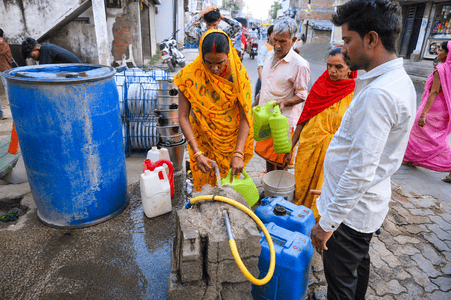
Indore is putting a price on water wastage. The city’s Mayor-in-Council on Monday unanimously approved a new water policy under which residents can be fined for wasting water or for drawing it from tap connections with motor pumps. The aim, according to the civic body, is to conserve every drop and help Indore become one of the country’s leading water-secure cities.
What the Fines Look Like?
The penalties rise with each repeat offence, according to an official release.
For wasting water:
- First offence: ₹2,000
- Second offence: ₹5,000
- Third and every repeat offence: ₹10,000
For using a motor pump on a tap connection:
- First violation: ₹5,000
- Second and subsequent violations: ₹10,000
The structure is a familiar one in municipal water management. A modest first penalty works as a warning, and the steeper amounts for repeat offenders are meant to change behaviour rather than raise revenue.
Fines Are Meant as a Last Resort
Mayor Pushyamitra Bhargava, who chaired the meeting, asked residents to treat water conservation as a shared responsibility. He said the aim is that the corporation should never need to take punitive action, and urged citizens to avoid wastage. The civic body will also run public awareness campaigns alongside the penalties.
What the Policy Is Trying to Achieve?
Beyond fines, the policy sets out wider goals. It aims to:
- conserve every drop of water
- recharge groundwater through rainwater harvesting
- treat and reuse wastewater
- reduce dependence on external water sources
- prevent pollution and protect lakes, ponds and other natural sources
- fix accountability in water management and ensure citizens’ participation
Having followed urban water issues for many years, I would say the policy’s strength is that it pairs enforcement with supply-side and recycling measures. Fines alone rarely solve a shortage. Recharge and reuse do far more over time.
Preparing for a Possible Summer Shortage
The council also cited the possibility of a water shortage next summer because of deficient rainfall. It cleared a set of measures to strengthen drinking water supply:
- Drilling 300 new tubewells
- Installing motor pumps on 100 tubewells, with higher-head pumps where needed
- Buying 11 EV truck tankers of 300-litre capacity and 22 CNG truck tankers of 8,000-litre capacity, so water reaches every household
- Requiring leaks in hired tankers to be fixed within seven days, failing which the agency concerned will be penalised
A Window to Regularise Illegal Connections
For residents with unauthorised connections, a 21-day special drive to regularise illegal tap connections will run continuously from November 12. Anyone in that situation should use this window, since the new penalties make unregulated connections riskier.
Other Decisions From the Meeting
The council also took several decisions beyond water:
- Staff: Following a Supreme Court order, more than 1,800 corporation employees will be regularised. The mayor directed that all eligible employees be regularised so that no senior worker is left out. Contractual appointments were approved for over 3,000 safai sanrakshak posts to strengthen sanitation.
- Advertising: No new unipoles will be installed in the city. Instead, 140 new gantries will be built and run by the corporation’s market department, with advertisements shown for a fixed fee.
- Roads: A fresh tender will be issued to develop the remaining stretch from Sarwate Bus Stand via Juni Indore Bridge and Chandrabhaga to Machhi Bazaar Square under the Kayakalp scheme. Decisions were also taken on the link road connecting Airport Road to MR-5 and on the road from Tata Steel Square on MR-5 to Chhota Bangarda village.
- Flyovers and facilities: The council took up the shifting of storm water lines for flyovers at Radisson Square and Robot Square. It also considered the tender for a “Smart Hub Multi Sports and Recreational Facility” on land beneath the Keshar Bagh flyover under the PPP model.
- Maintenance and services: Tenders will be invited for annual maintenance of tubewells, handpumps, hydrants, fountains and other water supply assets across Zones 1 to 22. A standard operating procedure was approved for running crematoria and graveyards within municipal limits, and the reallocation of flats built under the Pradhan Mantri Awas Yojana was cleared.
What Residents Should Do Now?
- Avoid wastage: Fix leaking taps and avoid washing vehicles or floors with running hoses.
- Stop using motor pumps on tap lines, which now attract fines from the first violation.
- Regularise any unauthorised connection during the 21-day drive starting November 12.
- Consider rainwater harvesting, a stated goal of the policy.
FAQs
How much is the fine for wasting water in Indore?
- ₹2,000 for the first offence, ₹5,000 for the second and ₹10,000 for the third and every repeat offence.
What is the penalty for using a motor pump on a tap connection?
- ₹5,000 for the first violation and ₹10,000 for the second and subsequent ones.
Who approved the policy?
- The Mayor-in-Council approved it unanimously on Monday.
What does the policy aim to do?
- It aims to conserve water, recharge groundwater through rainwater harvesting, treat and reuse wastewater, and make Indore one of the country’s leading water-secure cities.
What is being done to prevent a summer shortage?
- The council cleared 300 new tubewells, motor pumps on 100 tubewells, and new EV and CNG tanker trucks.
When does the drive to regularise illegal tap connections start?
- A 21-day special drive will run continuously from November 12.