


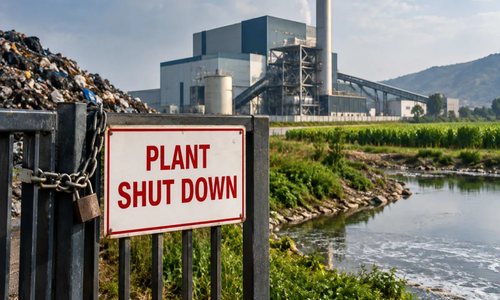
A 10 MW waste-to-energy incineration plant in Maharashtra’s Sangli district has been shut after sustained protests by villagers. They had raised concerns about pollution and its effect on public health, farming and local water sources. Closure orders were issued on September 23, 2026, by the sub-divisional officer and the sub-divisional magistrate of the Miraj sub-division.
The facility, run under the name Bhumi Green Energy, had faced opposition over its emissions, wastewater treatment and ash disposal. The shutdown followed a joint fact-finding exercise that produced a detailed list of alleged violations. That list is worth reading closely, because it shows how a plant that is meant to solve a waste problem can create a different one when it does not run as designed.
What happened in Sangli?
The sequence is fairly simple. Villagers protested against the plant over alleged pollution. Three groups then carried out a joint fact-finding exercise: Paryavaran Rakshan Samiti Sangli, the National Alliance for Climate and Ecological Justice, and the Centre for Financial Accountability. Their findings alleged that the facility had failed to comply with several environmental and operational requirements. The closure orders followed on September 23.
One point needs to be stated clearly. The allegations below come from the groups’ report. They are claims made by campaigners, and the report as described does not include a response from the plant’s operator. Readers should treat them as allegations until the authorities or the company say otherwise.
The key allegations, explained
1. A combustion chamber running far below the required temperature
This is the most technical allegation, and arguably the most serious. According to the groups, the plant’s secondary combustion chamber was operating at 230°C. The stated minimum requirement under the Solid Waste Management Rules, 2016 is 950°C.
Why does that gap matter? In an incinerator, the secondary chamber is where gases from the first burn are heated further so that harmful compounds break down. The groups said that lower temperatures could lead to incomplete combustion and the release of pollutants, including soot, acid gases, dioxins and furans. Dioxins and furans are a group of toxic chemical compounds linked to waste burning, and they are the reason temperature control is treated so strictly in incineration rules.
2. Wastewater treatment not working
The report alleged that the effluent treatment plant was not operating, even though continuous treatment and zero liquid discharge are required. Zero liquid discharge means a facility should not release untreated liquid waste into the environment.
The groups claimed that untreated leachate, the contaminated liquid that drains out of waste, was stored in unlined pits and overflowed into streams that feed the Warana River. For villagers who depend on local water for drinking and irrigation, this is the allegation that would worry them most.
3. Air pollution controls not functioning
The groups further claimed that the electrostatic precipitators and wet scrubbers, which are meant to capture particles and gases before they leave the chimney, were not working. They also alleged that black smoke escaped from the furnace and boiler sections.
4. No online emissions data
Modern pollution rules rely on continuous monitoring. The campaigners said that online emissions data was not being transmitted to the Central Pollution Control Board or the Maharashtra Pollution Control Board. If true, regulators would have had no live view of what was coming out of the plant.
5. Ash handling
The report also alleged that fly ash was left uncovered, and that bottom ash was used to fill low-lying land at at least 25 locations. Ash from waste incineration can contain contaminants, which is why how and where it is disposed of is regulated.
Was the plant even producing power?
The report also raises a question about performance. The plant’s installed capacity was 10 MW, equal to about 7.2 million units of electricity a month at full capacity. Average generation was reported at 2.38 million units, or about 33% of that level.
That figure matters because waste-to-energy plants are often promoted as a double solution: they deal with waste and they produce electricity. If a plant runs at only a third of its capacity, the case for it becomes weaker, particularly when local communities say they are living with the pollution.
The wider demand: a nationwide ban
The three groups used their findings to call for a nationwide ban on waste-to-energy incineration and for greater emphasis on reducing waste generation in the first place.
That is a strong position, and it is not the only view on the subject. Supporters of waste-to-energy argue that India’s cities produce huge volumes of waste, that landfills are running out of space, and that incineration, when run properly with all controls working, can reduce landfill load while generating power. Critics respond that the technology is only as good as its operation and monitoring, and that a plant that does not meet standards can harm the people nearby. The Sangli case sits right in the middle of this debate. It does not settle it, but it shows what the argument looks like on the ground.
Why this story matters beyond Sangli?
There are three reasons this case deserves attention.
First, it shows the importance of operation, not just design. A plant can be approved and built on paper to meet the rules. What counts is whether the temperature is held, the treatment plant runs and the filters work every single day.
Second, it highlights the role of local communities. The closure followed sustained protests by villagers, backed by an independent fact-finding exercise. Without that pressure, the issues described might not have reached the authorities.
Third, it raises a policy question. If cities are encouraged to adopt waste-to-energy as a solution, then strict, transparent monitoring has to come with it. Live emissions data that reaches the regulators is one of the basic safeguards, and the allegation here is that it was missing.
What to watch next?
Several questions remain open:
- Will the plant’s operator respond to the allegations, or challenge the closure orders?
- Will the Maharashtra Pollution Control Board or the Central Pollution Control Board carry out its own inspection and publish findings?
- What will happen to the waste that the plant was handling?
- Will the alleged ash dumping and leachate overflow be investigated or cleaned up?
- Will other waste-to-energy plants in the state face similar scrutiny?
Key takeaways
- A 10 MW waste-to-energy plant in Sangli district, Maharashtra, was shut following villagers’ protests, with closure orders issued on September 23, 2026.
- The orders were issued by the sub-divisional officer and sub-divisional magistrate of the Miraj sub-division.
- Three groups alleged that the secondary combustion chamber ran at 230°C against a required minimum of 950°C.
- They also alleged that the effluent treatment plant was not working, pollution controls had failed, emissions data was not being transmitted and ash was handled improperly.
- Average generation was about 2.38 million units a month, roughly 33% of the plant’s full capacity of about 7.2 million units.
- The groups are calling for a nationwide ban on waste-to-energy incineration.
Frequently asked questions
Which waste-to-energy plant was shut in Maharashtra?
- A 10 MW waste-to-energy incineration plant in Sangli district, operating as Bhumi Green Energy, was shut following villagers’ protests over alleged pollution.
When were the closure orders issued?
- On September 23, 2026, by the sub-divisional officer and sub-divisional magistrate of the Miraj sub-division.
What did the fact-finding report allege?
- The groups alleged that the combustion chamber ran far below the required temperature, the effluent treatment plant was not working, pollution control equipment had failed, online emissions data was not transmitted, and ash was handled improperly.
What temperature should the secondary combustion chamber maintain?
- The stated minimum requirement under the Solid Waste Management Rules, 2016 is 950°C. The groups said the chamber was operating at 230°C.
How much electricity did the plant produce?
- Average generation was reported at 2.38 million units a month, about 33% of its full-capacity output of about 7.2 million units.
Who carried out the fact-finding exercise?
- Paryavaran Rakshan Samiti Sangli, the National Alliance for Climate and Ecological Justice and the Centre for Financial Accountability.