


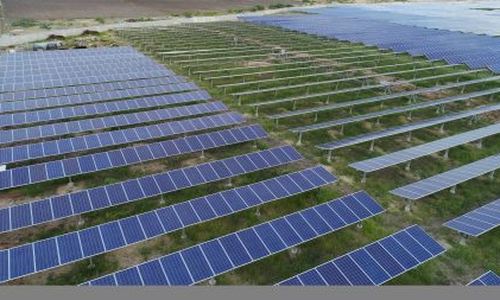
India still runs largely on coal, and it is also building clean energy faster than almost any other country. Both statements are true at once, and ignoring either one gives a distorted picture of where the world’s most populous nation is heading on climate.
The Criticism Is Fair, but Incomplete
Much of the Western climate conversation casts India as a coal-dependent laggard whose rising emissions could cancel out gains made elsewhere. The concern has a factual basis. UNEP data reported by Mongabay India show that India recorded the world’s largest absolute rise in emissions in 2024, and thermal plants still generate about 70 percent of its electricity.
Those numbers describe where India stands today. They say little about the direction it is travelling.
A Record of Beating Its Own Targets
At the 2015 Paris climate conference, India pledged that 40 percent of its installed power capacity would come from non-fossil sources by 2030. According to the Press Information Bureau (PIB), it met that goal in November 2021, almost a decade early. India then raised the bar to 50 percent and, as Enerdata reports, crossed that line in June 2025, five years ahead of schedule.
The scale of the build-out supports that record:
| Milestone | Detail |
|---|---|
| Non-fossil capacity | Passed 300 GW in July 2026, more than half of total installed capacity |
| Clean capacity added in FY2025-26 | A record 55 GW |
| Global ranking | Third in the world for installed renewable energy |
| Renewables’ share of demand | More than half of electricity demand on July 29, 2025, a record |
The Indian government called that last milestone “a remarkable sign of change.”
Why India’s Path Is Different?
Many of today’s rich economies industrialized on coal for more than a century before turning to cleaner fuels. India is trying to do both things at the same time: expanding electricity access and industrial growth for 1.4 billion people while building one of the largest clean-energy systems in the world. That is a harder task than the one earlier industrial powers faced.
The Challenges That Remain
Capacity is not the same as generation. More than half of India’s installed capacity is now non-fossil, yet those sources produce under a third of the electricity the country consumes. Solar output peaks in the afternoon, while demand often peaks in the evening. The storage and transmission networks needed to bridge that gap are still under construction, and until they are ready, coal will remain the backbone of reliable supply.
Demand keeps climbing. Fast economic growth, urbanization and more frequent heatwaves are pushing electricity use higher, as Down To Earth has reported. This is why India’s total emissions continue to rise even as its power mix gets cleaner. Clean capacity is arriving quickly, but demand is growing almost as fast.
Heavy industry is hard to clean up. Steel and aluminum are among the most difficult sectors to decarbonize, and Indian exporters now face carbon border rules in key markets. The Global Trade Research Initiative (GTRI) estimates that Indian steel and aluminum exporters may need to cut prices by 15 to 22 percent to stay competitive in Europe. Smaller firms struggle most with the cost of measuring and reporting their emissions.
Finance is the tightest constraint. A transition of this size needs enormous investment, much of it in grids and storage that take years to pay back. At COP29, India objected to the new climate finance goal of $300 billion a year, which was less than a quarter of the $1.3 trillion developing countries had asked for.
Signs That Policy Is Catching Up
India’s national carbon market became operational in January 2025, giving industry a price signal to cut emissions. Growth in the country’s fossil fuel emissions is also projected to have slowed sharply in 2025, according to a report covered by The Hindu.
Energy Transitions Are Never Straight Lines
Western experience shows the same pattern. During the 2022 energy crisis, several European countries temporarily went back to coal to keep supply steady, before renewable growth picked up again, as the IEA’s coal report noted. That was a reasonable response to an emergency. It also shows that every country weighs climate goals against energy security and affordability. India faces the same trade-offs at a lower income level, with more of its people still gaining reliable power.
What International Partners Can Do?
Outside partners can help in practical ways:
- Finance grids and battery storage. This would directly address the gap between capacity and generation.
- Recognize domestic carbon pricing. Giving credit for schemes like India’s carbon market could ease the burden of border carbon rules on smaller exporters.
- Build on the International Solar Alliance. India co-founded the alliance, which already offers a base for wider cooperation on clean technology and supply chains.
A Fairer Way to Judge India
Coal will stay in India’s energy mix for some time, and the obstacles are real. But judging climate commitment by coal dependence alone risks misreading one of the largest clean-energy transitions anywhere.
The better question is not whether India still uses coal, but whether it is moving decisively away from it. A fairer yardstick would weigh a country’s direction of travel, per capita emissions and historical responsibility alongside its current energy mix. On those measures, the picture looks different. According to Our World in Data, the average Indian emits about 2.2 tonnes of carbon dioxide a year, less than half the global average, and India has contributed under 4 percent of cumulative CO2 emissions since the industrial revolution.
Future analysis of India’s climate role should account for both what it has achieved and the constraints shaping its choices.
Frequently Asked Questions
Is India still dependent on coal?
- Yes. Thermal power generates around 70 percent of India’s electricity, and coal will remain the backbone of reliable supply until storage and transmission networks catch up.
How much of India’s capacity is non-fossil?
- Non-fossil capacity passed 300 GW in July 2026, which is more than half of the country’s total installed capacity.
Did India meet its Paris climate target?
- Yes, and early. India reached its 40 percent non-fossil capacity goal in November 2021 and crossed the raised 50 percent threshold in June 2025.
Why are India’s emissions still rising?
- Demand is growing almost as fast as clean capacity. Economic growth, urbanization and heatwaves are all pushing electricity consumption up.
What is India’s per capita carbon footprint?
- About 2.2 tonnes of CO2 a year, less than half the global average.