


India Adds Record 51 GW of Solar in 2025, Ranks Second Only to China as Rooftop Boom Takes Hold
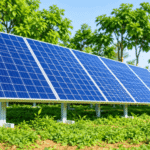
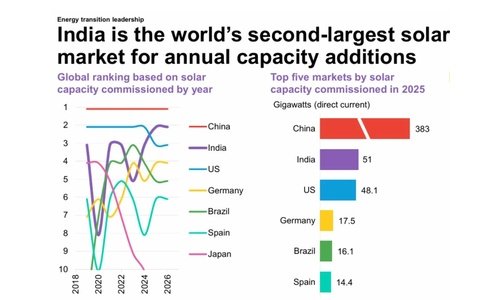
India installed a record 51 GW (direct current) of solar capacity in 2025, according to a new BloombergNEF (BNEF) report. That was 55% more than the previous record, set in 2024. It also made India the largest market for new solar capacity outside China, ahead of the United States.
Rooftop solar did much of the heavy lifting. The segment grew faster than any other, helped by capital expenditure subsidies under the PM Surya Ghar scheme. Support for small decentralised agrivoltaic projects, mostly under PM-KUSUM, added to the momentum.
Key Takeaways
- Solar: India added 51 GW (DC) in 2025, up 55% on 2024. BNEF expects another 52 GW in 2026.
- Ranking: India overtook the US as the biggest solar market outside China.
- Rooftop: the fastest-growing solar segment, with almost 6 million households having used PM Surya Ghar so far.
- Wind: record additions of 6.3 GW made India the world’s second-largest wind market in 2025, up from fifth place.
- Cost: India has the world’s lowest levelised cost of electricity (LCOE) for utility-scale solar.
- Storage: solar and wind paired with four-hour batteries undercut coal on LCOE for the first time in the second half of 2025.
Rooftop Solar Leads the Surge
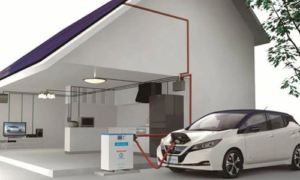
The 2025 numbers reflect a shift in who is putting solar on the grid. For years, large utility-scale plants set the pace. Now households are a serious force. Almost 6 million homes have availed of PM Surya Ghar, and BNEF names rooftop as India’s fastest-growing solar segment. The scale of that change would have been hard to imagine before the scheme arrived, and the government deserves credit for delivering on most of its main objectives.
Decentralised agrivoltaic projects remain a small segment, but state support for them, mostly through PM-KUSUM, has also fed into the overall growth.
India has raised its annual solar additions every year since 2023. BNEF’s forecast of 52 GW for 2026 would keep the country in second place globally this year.
Storage Is the Next Piece
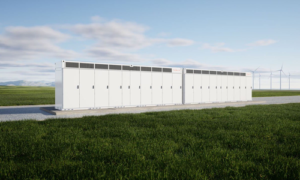
Solar output peaks at midday, while demand often peaks in the evening. BNEF suggests that co-locating energy storage systems (ESS) with solar plants can improve project economics by moving supply into those evening hours. The fast pace of solar additions has already pushed daytime power prices close to zero on several occasions, which makes that argument harder to ignore.
India Becomes the World’s Second-Largest Wind Market
Wind had its own breakthrough year. India added a record 6.3 GW in 2025, overtaking the US and Germany to become the second-largest wind market, up from fifth in 2024. The 2025 total was nearly double the previous year’s and about 50% above the earlier record, set in 2017.
Part of the jump came from projects that had been stuck for a long time because of land acquisition and grid connection problems. Wind matters for a solar-heavy system because it can supply power beyond daylight hours, and wind projects tend to perform well in the windier monsoon season.
Auction design is pushing the same way. Government-run, multi-technology renewable energy auctions increasingly ask developers to deliver firm, or assured, electricity. That encourages bidders to pair generation with storage.
The World’s Cheapest Utility-Scale Solar
BNEF says India has the lowest LCOE for utility-scale solar anywhere. A large share of those projects sits in Rajasthan and Gujarat, where clear skies support strong output for much of the year. Government-developed solar parks in both states give developers large, flat, contiguous plots of land, which keeps development simpler and cheaper.
Solar and Wind With Four-Hour Batteries Now Beat Coal on Cost
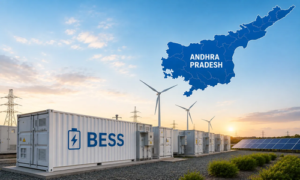
Standalone solar and wind have been India’s cheapest source of new bulk power since 2018, based on BNEF’s LCOE estimates. The more recent milestone is about storage. In the second half of 2025, Indian solar and wind projects paired with four-hour battery energy storage systems (BESS) came in below coal-fired plants for the first time, under BNEF’s mid-case scenario.
Falling battery prices are the main reason. BNEF projects that turnkey costs for a four-hour system in China could drop from $62/kWh in 2025 to $48/kWh by 2030. In Europe, the projected fall is from $172/kWh to $125/kWh over the same period. Those global declines are likely to push storage costs down in India too. As developers gain experience from the country’s first projects and execution improves, the cost of renewables paired with storage could fall further.
Corporate Buyers and Grid Rules
Companies operating in India signed about 2.3 GW of clean power purchase agreements (PPAs) in 2026 through September. That made India the largest Asia-Pacific market for such deals this calendar year.
On the regulatory side, the Central Electricity Regulatory Commission (CERC) is tightening deviation settlement mechanism (DSM) rules for renewable generators. The aim is to support grid stability as the share of variable generation rises.
Wind and solar supplied 16% of India’s electricity in 2025. Under BNEF’s economics-led scenario, their combined share could reach 41% by 2035.
The Investment Bill Ahead
Growth of this size needs a stronger grid. BNEF expects investment in new connections, grid assets and reinforcement of the existing network to average $53 billion a year through 2050.
Renewable energy and storage would need a further $1.5 trillion over the same period. Solar and wind are each expected to account for roughly $500 billion. On an annual basis, that works out to about $40 billion for renewable assets and $19 billion for energy storage.
Subsidies Support Standalone Storage
Government support is also shaping the storage market. Under the viability gap funding mechanism, eligible standalone storage projects receive about ₹18 lakh (around $18,700) per MWh. The support is meant to cover roughly 15% to 20% of project capital expenditure, which improves project viability and encourages investment.
What to Watch Next?
Three things will decide how this story continues: whether solar additions reach the 52 GW BNEF expects for 2026, how quickly storage is paired with new projects, and whether grid upgrades keep pace with generation. Rule changes such as CERC’s tighter DSM norms will also shape how comfortably a renewable-heavy system runs.
Frequently Asked Questions
How much solar did India add in 2025?
- India added 51 GW (DC) of solar capacity in 2025, 55% more than the previous record set in 2024, according to BNEF.
Is India the second-largest solar market?
- Yes. India overtook the US in 2025 to become the largest market for new solar capacity outside China. BNEF expects it to hold second place in 2026 with about 52 GW of additions.
What drove the growth in rooftop solar?
- Capital expenditure subsidies under PM Surya Ghar. Almost 6 million households have availed of the scheme so far.
How much wind power did India add in 2025?
- A record 6.3 GW, which made India the world’s second-largest wind market, up from fifth place in 2024.
Why is solar so cheap in India?
- BNEF ranks India’s utility-scale solar as the world’s lowest in LCOE. Strong sunshine in Rajasthan and Gujarat and government-developed solar parks with large flat land parcels both help.
Is renewable power with batteries cheaper than coal in India?
- In the second half of 2025, solar and wind paired with four-hour BESS fell below coal on LCOE for the first time, under BNEF’s mid-case scenario.