



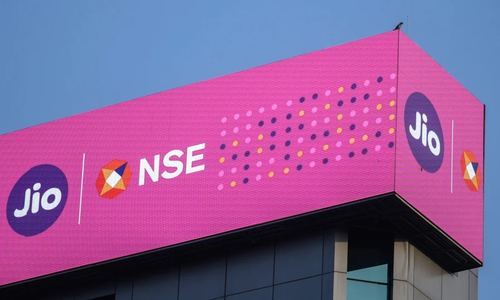
Shares of Reliance’s digital and telecom arm opened around ₹1,357 on Wednesday, nearly 21.3% above the upper end of the ₹1,119 price band.
Jio Platforms made its Dalal Street debut on Wednesday, 28 October, with shares opening at about ₹1,357 on both the BSE and NSE. That is roughly 21.3% higher than the issue price of ₹1,119, the upper end of the IPO price band. On the NSE, the stock trades under the symbol “JPL”.
How the listing played out?
In the pre-open session, the shares were indicated at around ₹1,358 on both exchanges, a premium of ₹239, or about 21.3%, over the issue price. The final listing price was broadly in line with the grey market premium (GMP) seen ahead of the debut. The GMP is an unofficial indicator of demand, not a guaranteed forecast, but in this case it pointed in the right direction.
Soon after listing, the stock held close to its opening level and traded almost flat. The broader market was softer at the same time. As of 9:15 am, the Nifty 50 was down 0.32% at 22,678, and the Sensex had slipped 0.47% to 73,253.44.
What the Ambanis said at the ceremony?
At the listing ceremony in Mumbai, Reliance Industries Executive Director Anant Ambani thanked what he called the millions who believed in Jio. He said the exchange bell was ringing for him like a temple bell, because business, in his words, is “puja”, and the “prasad” that follows is always shared.
Akash Ambani, Chairman of Reliance Jio Infocomm Limited, spoke about Jio’s reach. He described a young girl named Anjali from a hilly pocket of Kerala who once walked two kilometres uphill every day just to find a data signal to download her school lessons. With Jio, he said, that walk is no longer needed. He added that the listing bell also stands for millions of other “Anjalis” across the country, and that success should be judged by the ambitions it encourages and the potential it unlocks.
A quick primer: how an IPO works
For readers new to the market, an initial public offering (IPO) is the process through which a company sells shares to the public for the first time. Companies usually do this to raise money for expansion, to repay debt, or for other business needs.
Before the issue opens, the company announces a price band. For Jio Platforms it was ₹1,065 to ₹1,119 per share. Investors apply through their trading platform or broker, stating how many shares they want and, where applicable, the price they are willing to pay. The application amount is blocked in the bank account until allotment is complete.
If applications exceed the shares on offer, an investor may receive fewer shares than applied for, or none at all. After allotment, the shares list on exchanges such as the BSE and NSE. The listing price depends on demand and supply on the day and can be higher or lower than the IPO price.
What to keep in mind?
A strong listing premium reflects demand on day one, but it does not decide how the stock behaves over the following weeks. Investors usually watch the company’s earnings, subscriber growth and broader market conditions before drawing conclusions.
This article is for information only and is not investment advice. Readers should consult a SEBI-registered adviser before making investment decisions.
Frequently asked questions
At what price did Jio Platforms list?
- Shares opened at around ₹1,357 on BSE and NSE, with pre-open indications near ₹1,358.
What was the IPO issue price?
- The issue price was ₹1,119, the upper end of the ₹1,065 to ₹1,119 price band.
What was the listing premium?
- About 21.3% over the issue price, or roughly ₹239 per share at the pre-open level.
What is Jio Platforms’ NSE symbol?
- The stock trades as “JPL” on the NSE.
What is the grey market premium (GMP)?
- It is an unofficial indicator of demand for an IPO before listing. It is not regulated and not a guaranteed predictor.
What happens if an IPO is oversubscribed?
- Applicants may get fewer shares than they applied for, or no allotment at all.