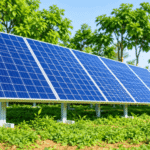





Botswana is preparing to add a large battery next to one of its biggest solar plants. Botswana Power Corporation (BPC) has published plans for a 25MW battery system with 100MWh of storage beside the Mmadinare solar cluster, with the World Bank expected to fund its construction. The announcement comes just as the country presents its climate plan at COP31 in Antalya, where it ranks energy generation as its biggest opportunity for carbon market activity.
What BPC is planning?
The plan is set out in a revised environmental and social management plan (ESMP) dated 6 November. It was submitted to the Department of Environmental Protection in Selebi Phikwe.
The key details:
- Size: 25MW of power and 100MWh of storage
- Equipment: 20 battery containers and five power conversion units
- Location: 2 hectares of a 40-hectare plot, about 8km south-east of Mmadinare in the Bobirwa District, next to the 100MW Mmadinare Solar PV Cluster
- Funding: the World Bank is to fund the initial construction
- Timeline: construction is pencilled in for 2027 and is expected to take 9 to 12 months
The battery is designed to firm up the output of the neighbouring solar plant. It will also provide peak-shaving and frequency services for the region. In simple terms, it will store solar power when the sun is strong and release it when demand rises, which helps keep the grid steady.
The solar plant it will sit beside
The Mmadinare cluster has performed well so far. By its official launch on 31 August, more than 243,288MWh had been fed into the grid. BPC Chief Executive David Kgoboko says availability and reliability have stayed above 99% since operations began.
The plant was built and is owned by Scatec, the Norwegian independent power producer. It sells its electricity to BPC under a 25-year power purchase agreement.
Solar is already changing the grid
Statistics Botswana’s figures show how quickly the picture is shifting. Solar plants at Bobonong, Phakalane, Shakawe and Mmadinare produced about 82,520MWh in the first quarter of 2026. That was 9.1% of domestic generation, up from 3.2% a year earlier.
Over the same period, imports fell 29.8% compared with the previous quarter. Even so, the Morupule A and B coal plants still supplied 90.8% of locally generated power. The numbers show real progress, but also how much of the system still depends on coal.
The wider energy push
Under its revised Integrated Resource Plan, the government wants renewables to supply 50% of the generation mix by 2030, up from about 8% today.
Other projects are already moving:
- Maun: In April, President Duma Boko broke ground on a 500MW solar plant with a 500MWh battery. BPC is delivering it with Okavango Solar under a government-to-government partnership with Oman, backed by a 30-year power purchase agreement.
- World Bank programme: The Renewable Energy Support and Access Accelerator project was approved in July 2024 with an $88 million loan and $34 million in Green Climate Fund finance. It includes 50MW of utility-scale battery storage.
What Botswana is taking to COP31?
Botswana’s third nationally determined contribution (NDC) is being presented by its delegation at COP31. It rates energy generation as having the largest potential for carbon market activity. Nature-based removals are seen as a significant opportunity. Bushfire management and refrigerant transitions are rated moderate, and energy efficiency is expected to deliver a lower volume.
A draft carbon market framework is targeted for the first quarter of 2027. Its approach is to keep the cheaper mitigation for Botswana’s own target and offer higher-cost activities abroad as internationally transferred mitigation outcomes under Article 6. The plan names both Article 6.2 and the Paris Agreement Crediting Mechanism as suitable routes for energy generation.
The money involved
- Unconditional mitigation (2026–2035): $224 million
- Conditional mitigation (2026–2035): $1.5 billion
- Earlier estimate: the second NDC, submitted in December 2024, put the conditional need to 2030 at $2.7 billion, of which about $50 million has been secured
- COP31 ask: the government will seek $4.32 billion in climate finance
On removals, the NDC cautions against overselling the low-cost mitigation Botswana needs to meet its own unconditional target.
Approvals still needed
- Before the battery can be commissioned, it will need grid-connection and regulatory approvals from the Botswana Energy Regulatory Authority (BERA), according to the ESMP.
There is also a policy change on the way. Amendments to BERA’s Act that would recognise independent transmission providers and introduce electricity trading are due before Parliament in its November sitting. BERA Chief Executive Never Tshabang spoke about this at the National Business Conference in Francistown in October.
Impact on local communities
Fieldwork for the ESMP found nobody living on the 40-hectare plot, which the Ngwato Land Board allocated to BPC. This means no resettlement plan is needed.
The battery compound will fence off only about 2 hectares. The remaining 38 hectares stay open for neighbouring farmers’ livestock and for communities who gather non-timber forest products there.
Why it matters?
Solar power is only as useful as the grid’s ability to use it when it is needed. By storing midday output for the evening peak, this battery could make the Mmadinare plant more dependable and reduce reliance on imports and coal. It will also be an early test of how Botswana’s regulators, financiers and utility handle large-scale storage as the country works towards its 2030 target.
FAQs
How big is the planned battery at Mmadinare?
- It will be a 25MW system with 100MWh of storage, made up of 20 battery containers and five power conversion units.
Who is paying for it?
- The World Bank is expected to fund the initial construction.
When will it be built?
Construction is pencilled in for 2027 and should take 9 to 12 months.
What will the battery do?
- It will firm up the output of the adjoining 100MW solar cluster and provide peak-shaving and frequency services for the region.
Does the project need any more approvals?
- Yes. It needs grid-connection and regulatory approvals from the Botswana Energy Regulatory Authority before commissioning.
Will anyone be displaced by the project?
- No. Fieldwork found nobody living on the plot, so no resettlement plan is needed. About 38 of the 40 hectares will remain open for livestock and the collection of forest products.