


India’s Clean Energy Transition: Renewables Cross 200 GW, Nearly 45% of Installed Capacity
India’s renewable energy capacity has crossed 200 GW and now makes up nearly 45 per cent of the country’s total installed electricity capacity, according to Sneha Desai. The article argues that the shift is delivering economic growth, energy security and jobs together, and sets out what the next phase looks like.
Over the past 12 years, India has moved from heavy dependence on conventional fuels to becoming one of the fastest-growing renewable energy markets in the world. The government’s stated principle is that economic growth and environmental responsibility must move together. Here is what has changed, and what comes next.
Key Takeaways
- Renewable energy (RE) capacity has crossed 200 GW, driven mainly by solar and wind.
- RE accounts for nearly 45 per cent of total installed electricity capacity.
- Thermal and nuclear power still play a key role in meeting baseload demand.
- PM Surya Ghar: Muft Bijli Yojana and PM-KUSUM are pushing rooftop and farm-based solar.
- Production Linked Incentive (PLI) schemes are expanding domestic manufacturing of solar modules, cells, inverters, batteries and wind turbines.
- The National Green Hydrogen Mission targets hard-to-decarbonise sectors such as steel, fertilisers, refineries, shipping and heavy transport.
How Big Is India’s Renewable Energy Capacity?
India’s renewable capacity has crossed the 200 GW mark. Solar and wind power have driven most of that growth. Renewables now account for nearly 45 per cent of all installed electricity capacity, which places India among the fastest-growing renewable markets globally.
The author attributes this to policy reforms, transparent auctions, investor-friendly regulations and a stable governance framework, which he says have built confidence among domestic and international investors.
It is worth reading the 45 per cent figure carefully. It refers to installed capacity, meaning how much power plants can produce, not the share of electricity actually generated in a year. Coal-based thermal plants continue to supply a large share of the power that homes and industry use. The article itself notes that thermal and nuclear power remain essential for meeting growing baseload demand, the steady round-the-clock supply that solar and wind cannot yet provide alone.
Solar Takes Centre Stage
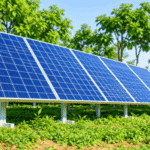
Solar power has been the most visible part of the shift. Two flagship schemes are at the centre of it:
- PM Surya Ghar: Muft Bijli Yojana promotes rooftop solar so households can cut their electricity bills.
- PM Kisan Urja Suraksha evam Utthaan Mahabhiyaan (PM-KUSUM) helps farmers move away from unreliable grid supply and rising diesel costs, and lets them become energy producers themselves.
Beyond rooftops and farms, large solar parks, floating solar installations, offshore wind projects and hybrid renewable systems are adding capacity at what the article describes as an unprecedented pace.
Building Clean Energy Equipment at Home
Under the Atmanirbhar Bharat and Make in India initiatives, India has been building a domestic manufacturing base for solar modules, photovoltaic cells, inverters, battery storage systems, wind turbines and related equipment.
PLI schemes and supportive industrial policies have helped raise local capacity and reduce reliance on imports. The article says this has created thousands of direct and indirect jobs, particularly for young engineers, technicians, researchers, entrepreneurs and skilled workers.
Green Hydrogen: The Next Frontier
The article identifies green hydrogen as the next big step. The National Green Hydrogen Mission aims to make India a global hub for producing, using and exporting it.
Green hydrogen is made using renewable electricity, and its main promise is in industries that are hard to clean up with electricity alone. These include steel, fertilisers, refineries, shipping and heavy transport. If the mission succeeds, it could change how these sectors are powered. For now, the article describes this as potential, not a finished result.
India’s Role in Global Climate Talks
India has also taken a leading role through the International Solar Alliance, which the author says was conceived under Prime Minister Narendra Modi’s leadership. The alliance is presented as evidence that climate leadership is not limited to wealthy economies, and that developing countries can offer affordable, scalable solutions.
The author argues that India’s climate commitments carry credibility because they are backed by measurable progress, and that this has strengthened its position in international climate negotiations.
What Clean Energy Means for Everyday Life?
The article also stresses the social side of the transition. Reliable electricity supports education, healthcare, digital connectivity and rural enterprises. Women, it says, are benefiting from better access to energy, and rural communities are finding new income through decentralised renewable systems.
What Comes Next?
The author says India remains committed to its national climate goals and plans to strengthen energy independence, speed up innovation, expand domestic manufacturing and build a more resilient energy system.
Progress on these fronts can be checked against public data, including capacity figures from the Ministry of New and Renewable Energy (MNRE) and the Central Electricity Authority (CEA), and against project and manufacturing announcements over the coming months.
FAQs
What is India’s clean energy transition?
- It is the shift from coal, oil and other conventional fuels toward renewable sources such as solar, wind and hydro, along with newer options such as green hydrogen. The aim is to grow the economy while cutting emissions and dependence on imported fuel.
How much renewable energy capacity does India have?
- According to the article, India’s renewable capacity has crossed 200 GW, or nearly 45 per cent of total installed electricity capacity.
What are PM Surya Ghar and PM-KUSUM?
- PM Surya Ghar: Muft Bijli Yojana promotes rooftop solar for households. PM-KUSUM supports farmers in using solar power and reducing dependence on grid electricity and diesel.
Why does India still rely on thermal and nuclear power?
- Both provide steady, round-the-clock supply. The article says they remain important for meeting growing baseload electricity demand alongside renewables.
What is the National Green Hydrogen Mission?
- It aims to make India a global hub for producing, using and exporting green hydrogen, especially for sectors such as steel, fertilisers, refineries, shipping and heavy transport.
What is the International Solar Alliance?
- It is a global partnership for promoting solar energy. The article says it was conceived under Prime Minister Modi’s leadership and shows that developing countries can lead on climate solutions.