



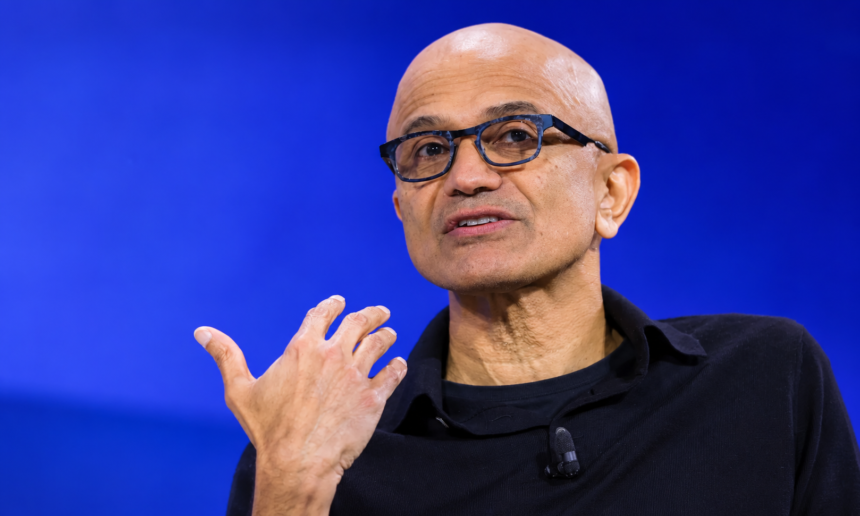
Microsoft CEO Satya Nadella has finally explained the thinking behind one of the company’s most talked-about decisions this year. On Wednesday, he spoke about why Microsoft offered voluntary buyouts to around 60,000 employees in October, a move that in effect invited people to leave without the company announcing another round of mass layoffs.
His short answer is AI, though not in the way most people assume.
Not “AI replaces people,” but “AI changes the job”
Nadella was careful to separate his strategy from the popular fear that machines are simply taking over human roles. He is not saying Microsoft is swapping engineers for AI. His argument is that the company is being rebuilt so that everyone uses AI in their daily work, and that a large part of each person’s job becomes directing and managing that AI.
Speaking at a business conference in New York, he told interviewer Andrew Ross Sorkin that the buyout was meant “to make sure that at least everyone felt like they had agency in making choices.” In other words, employees could decide for themselves whether to stay and adapt, or step away.
Software engineering: from doubt to panic to a new reality
Nadella used software engineering as his main example, and described how the industry’s mood has swung in a short time.
First, he said, the common view was that AI could never really write software. Then the pendulum went the other way, with people assuming AI could do all of it and asking why engineers were needed at all. Now, in his words, the industry is rediscovering that software engineering is “very much alive” and will thrive. The difference is that the way teams are organised, and the work an engineer actually does, has moved to what he called “a new operating point.”
He admitted this is not an easy transition. “That reorganization and change is sort of hard,” he said, but added that “it has to be done.”
The 11-person team behind Cowork
To show what this looks like in practice, Nadella pointed to the team that builds Cowork, the AI agent inside Microsoft 365 apps. By his account, it is made up of just 11 developers who have mastered working with AI.
His description of their role was striking: “They build a software factory that builds the product. They don’t build the product.”
He believes this pattern will spread well beyond engineering. Eventually, he suggested, nearly every employee will act more like a manager of AI agents than someone who does each task by hand. “That level of direction is what, by the way, is going to happen in all jobs,” he said.
Why a 51-year-old company finds this hard?
Nadella was frank that Microsoft did not begin life as an AI-first company, and that older, established firms have a harder road. The real question, he said, is how quickly an incumbent can change “the work, the workflow, and the work artifact,” along with the wage support that comes with it.
His expectation is that this will take longer than most people think. And along the way, he said, some people will conclude that they want to make “other choices” for themselves.
The anxiety he says the industry created
Nadella returned to the same theme last week in a podcast conversation with Gergely Orosz, where he addressed the emotional side of the shift.
He said the way the AI revolution has been discussed has left many people anxious, feeling they have no control over their own future. He pointed specifically to talk of the singularity, the hypothetical moment when AI surpasses human intelligence, and to predictions that AI will eliminate all jobs. According to him, that kind of messaging makes even people who are open to change feel uneasy.
His answer is practical rather than rhetorical: companies have to “walk the hard walk” of making structural changes, finding new roles for people, and giving them real opportunity.
What the buyout really signals?
Read together, Nadella’s comments make Microsoft’s message fairly clear. Employees were being offered a choice. They could commit to an AI-first way of working that will change their jobs significantly, or they could take the buyout and move on with their lives elsewhere.
Whether the approach proves kinder and more effective than a conventional layoff is something only time will show. But it tells us a lot about how one of the world’s biggest technology companies expects work to look in the years ahead.
Frequently Asked Questions
Why did Microsoft offer buyouts to around 60,000 employees?
- According to Satya Nadella, the goal was to give employees agency over their own choices while the company restructures around AI. He framed it as an alternative to a large layoff.
Is Microsoft replacing software engineers with AI?
- No, Nadella says. He argues that software engineering will continue to thrive, but that the work will change, with engineers spending more time directing AI systems and less time writing everything themselves.
What did Nadella say about the team that builds Cowork?
- He said the team has just 11 developers who have mastered using AI, and that they build a “software factory” that produces the product, rather than building the product directly.
Does Nadella think this applies beyond software?
- Yes. He expects people in all kinds of jobs to eventually become managers of AI agents rather than doing every task themselves.
Why does Nadella say the transition is difficult for Microsoft?
- Because Microsoft, a 51-year-old company, did not start as an AI-first business. He says transforming the work, the workflow and the outputs takes time, and will likely take longer than most people expect.