


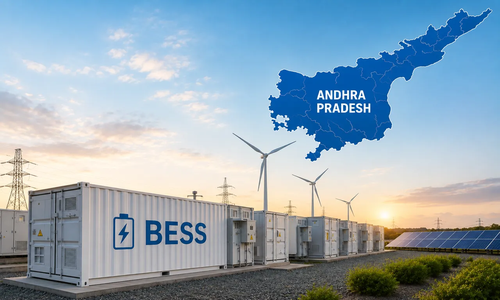
The Andhra Pradesh Power Transmission Corporation Limited (APTRANSCO) has invited bids from developers to set up 1,250 MW/5,000 MWh of standalone battery energy storage capacity, with four hours of storage. Bids are open until 23 November 2026.
What the Tender Covers?
The tender seeks developers for Battery Energy Storage Systems (BESS) under the Build-Own-Operate (BOO) model. The state says the aim is to provide power on demand, and the four-hour duration means each system can discharge at its rated output for four hours.
The capacity is split across three sites:
| Project | Location | Connection point | Proposed capacity |
|---|---|---|---|
| Project 1 | Rayalaseema Thermal Power Plant (RTPP) | 400 kV substation | 500 MW / 2,000 MWh |
| Project 2 | Talaricheruvu RE project | 220 kV pooling substation | 250 MW / 1,000 MWh |
| Project 3 | NP Kunta RE project | 220 kV NP Kunta pooling substation | 500 MW / 2,000 MWh |
Two of the three sites sit alongside renewable energy projects, which makes sense for storage. A battery located at a solar or wind pooling point can absorb surplus generation and release it later, instead of letting it go to waste.
Room to Expand: The Green-Shoe Option
The tender also gives the procurer, referred to in the documents as APPCC, the right to buy extra BESS capacity of up to 25 per cent of what is specified for each project (Clause 4.8). The maximum additional capacity is:
- 125 MW/500 MWh each for Project 1 and Project 3
- 50 MW/200 MWh for Project 2
These figures are subject to rounding to the nearest permissible BESS block configuration under the Request for Selection (RfS). Once APPCC allocates the extra capacity, it becomes part of the project’s total and contracted capacity. Adding the three maximums together, the green-shoe option could bring up to 300 MW/1,200 MWh of additional storage.
What Developers Must Take On?
The BESS developer (BESSD) carries a good deal of responsibility under this tender:
- Evacuation and interconnection: The developer must build, at its own cost and risk, all infrastructure needed to evacuate power and connect the project, up to and including the interconnection or delivery point. The exception is where the RfS expressly assigns that work to APTRANSCO.
- Land: The developer must secure access through a Right-of-Use arrangement with the land-owning entity, at an annual lease charge of ₹1 per acre.
The nominal land charge and the developer-borne interconnection cost both matter when a bidder works out project economics.
Why It Matters?
Standalone storage of this size lets a state shift energy from hours of surplus to hours of demand, and a four-hour system suits that kind of daily balancing. Placing it at a thermal plant and two renewable projects shows the state is looking at storage in several roles at once. Bidders will need to read the full RfS for eligibility, commercial terms and timelines, since this summary covers only what the tender announcement discloses.