




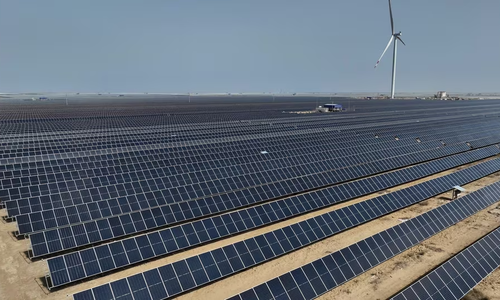
India has made real progress in building renewable energy capacity. The harder question now is how to fit that capacity efficiently into the power system. That is the argument made by Harish Saran, managing director of Hindustan Power Exchange Limited, who says the focus must shift from adding generation to building market mechanisms that can balance an increasingly dynamic grid.
A bigger, cleaner and more complex grid
The numbers show why the question is becoming urgent. According to Saran, electricity demand reached nearly 1,707 billion units in FY26, and peak demand touched a record 270.8 GW. Non-fossil sources now account for over 54% of installed capacity.
As the system grows, so does the difficulty of running it. In Saran’s view, simply adding more generation will not be enough without market tools that can respond to changing supply and demand.
The rise of exchange trading
India’s short-term power market has grown much faster than overall electricity consumption in recent years. Saran says exchange-traded volumes have risen from less than 3 billion units in the early years of power-market development to more than 168 billion units annually. Generators, distribution companies, traders and open-access consumers are all taking part, which makes exchanges an increasingly important place for price discovery and procurement.
The problem of split liquidity
Growth has created a new issue. Liquidity today is spread across several power exchanges. Saran notes that competition among exchanges encourages innovation and better service. But split liquidity can also lead to different market outcomes even when the underlying supply and demand are similar.
What market coupling would change?
Market coupling is meant to fix that. Bids from different exchanges would be pooled and cleared together through one common mechanism. Instead of each exchange setting its own price, the market would find a single outcome based on the combined group of buyers and sellers. According to Saran, this lets available supply be allocated more efficiently and raises overall economic welfare.
What the pilot results showed?
Saran points to shadow pilot exercises run by the Central Electricity Regulatory Commission (CERC). The day-ahead market coupling assessment showed welfare gains of about ₹38 crore and an additional 52 million units of power cleared during the pilot period. Similar exercises in the real-time market (RTM) indicated better market efficiency, with less price divergence and volatility.
These were pilot exercises, not a live rollout, so the results show potential rather than a final outcome.
Why it matters more as renewables grow?
Solar and wind output changes with the weather, while demand moves through the day. That creates a constant need to balance supply and consumption.
Saran says these dynamics are already visible in India. High solar output during the day is pushing prices down, while evening demand peaks often send prices much higher. Those price swings, he argues, highlight the growing value of flexibility, storage and demand-side response.
A coupled market, in his view, would sharpen these signals by offering a larger and more liquid pool of participants. That would let traders adjust positions more easily, which matters for managing forecast errors and changing grid conditions. Real-time market volumes have become one of the fastest-growing parts of India’s electricity markets, he adds, and liquidity there is likely to matter even more as renewables increase.
Better use of wires and new resources
Renewable resources are often concentrated in particular states, while demand may sit elsewhere. Saran argues a more integrated market would let power flow more efficiently from surplus regions to deficit regions, within the limits of network availability.
The same logic applies to newer resources such as battery storage, pumped-storage projects and demand response. Stronger and more representative price signals, he says, give these resources a clearer reason to operate when they deliver the most value to the grid.
One building block among several
Saran stresses that market coupling is not only about reaching one clearing price. He describes it as part of a broader marketplace where energy, flexibility and reliability can all be valued. It sits alongside other developments, including capacity markets, carbon credit certificate trading, virtual power purchase agreements and electricity derivatives.
What has to go right?
He also lists conditions for success. These include strong governance frameworks, harmonised market processes and effective surveillance. They also include continued investment in transmission networks, forecasting systems and digital infrastructure. Just as important, he says, is preserving competition and innovation while keeping market outcomes fair and transparent.
The bottom line
In Saran’s assessment, India’s clean energy goals will depend not just on how much renewable capacity is installed, but on how efficiently that energy is integrated, traded and consumed. He sees market coupling as a way to build a deeper, more liquid and more efficient market that supports a flexible, competitive and more decarbonised power system.
Frequently Asked Questions
What is market coupling?
- It is a mechanism that pools bids from different power exchanges and clears them together, so one market outcome is found from the combined group of buyers and sellers.
Why is it being discussed now?
- India’s exchange trading has grown quickly and liquidity is spread across several exchanges. Supporters say coupling could improve price discovery as renewables take a larger share of the grid.
What did the CERC pilot show?
- According to Saran, the day-ahead market pilot showed welfare gains of about ₹38 crore and an additional 52 million units cleared. Real-time market exercises showed less price divergence and volatility.
How could it help renewable energy?
- A larger, more liquid market could make it easier for participants to respond to changes in solar and wind output and to shifts in demand.
What are the risks or requirements?
- Saran says success needs strong governance, harmonised processes, effective market surveillance, and continued investment in transmission, forecasting and digital systems, while protecting competition.
Who is Harish Saran?
- He is the managing director of Hindustan Power Exchange Limited, and the views in this article are his.