


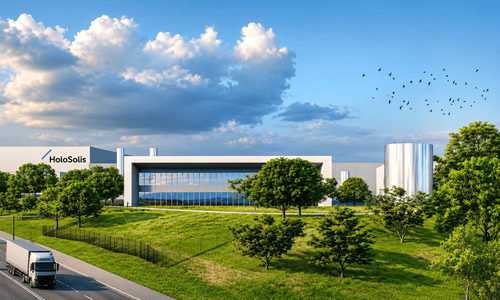
HoloSolis, the French solar manufacturer, now expects production at its planned 5-GW Hambach gigafactory to begin at the end of 2029 or early 2030. Its next big fundraising round depends on the EU passing a sufficiently ambitious Industrial Accelerator Act (IAA).
The company’s new chief executive, Henri Poupart-Lafarge, the former head of Alstom, laid out the revised plan in a detailed interview. It shows how much the future of European solar manufacturing now rests on one piece of legislation.
Key Takeaways
- New timeline: Fundraising for the first building is planned for mid-2027. Construction would start in mid-2028, and production at the end of 2029 or early 2030.
- Earlier targets: Previous statements pointed to construction in 2027 and first panels in 2028.
- Funding so far: HoloSolis has closed a EUR 15 million (USD 16.5 million) first round and has been granted around EUR 400 million in public financing from France and the EU.
- Customer interest: Letters of intent cover more than 30 GW of output. Firm contracts will follow only once the IAA is published.
- The big condition: The company wants strong, protective EU rules that create a market for European-made cells and modules.
Where the Hambach Project Stands?
The EUR 15 million round pays for the detailed engineering work. The company says the remaining milestones before construction are:
- Complete the detailed engineering.
- Conclude the relevant grant agreements.
- Advance the next financing steps.
- Finish procurement and construction preparations.
The larger fundraising round for the first building is the real hurdle. HoloSolis says it cannot finalise that round until the IAA is settled, and the legislation is expected to be finalised next year.
Why the Industrial Accelerator Act Matters So Much?
The company’s argument is simple. Without a protected share of the market, European-made panels struggle to compete with cheaper imports, and investors will not fund a factory that has no guaranteed buyers.
The IAA is expected to focus on two segments: public procurement and national auctions. Many solar projects are developed with government support. The aim is to direct that money toward projects that use European-made panels.
The CEO was open about the cost. European panels will be more expensive at first, and he argued governments should offer targeted, temporary support to offset the disadvantages created by subsidies, dumping and externalities in global markets. In return, he pointed to local jobs and additional tax revenue.
He also put the extra cost in context. Modules account for only 10% to 15% of a solar project’s capital expenditure, so the premium for European panels would be smaller than the rise in financing costs seen in recent months.
30 GW of Letters of Intent, but No Firm Contracts Yet
HoloSolis says it holds letters of intent covering more than 30 GW of production. That is over six times the plant’s planned 5-GW capacity, a clear sign of interest. Letters of intent are not binding, though. The company has said firm contracts will be signed only after the IAA is published, and only if the law is strong enough to recognise the value of European-made cells and modules.
Reliance on Imports and the China Question
The company does not claim it can do without imported inputs at the start. Some upstream materials, specialised equipment and components will have to be sourced internationally at first because European capacity is not yet available at scale.
HoloSolis says its priority is to reduce strategic dependency through European sourcing wherever possible. It points to existing European players:
- Ferroglobe in silicon extraction
- Wacker Chemie in refining
- ReSilicon (start-up) in silicon refining
- Sunwafe (start-up) in ingots and wafers
The company hopes to offer fully EU-made modules as soon as it can.
On China, the CEO was realistic. Complete decoupling is not possible in the short term, given China’s dominance in polysilicon and upstream manufacturing. A healthy balance, in his view, means Europe has enough domestic production to protect its strategic interests, keep industrial know-how and keep deployment going during geopolitical or supply-chain shocks. Imports can stay in the market, but as a complement to European production rather than a replacement for it. He called the EU’s goal of making at least 40% of deployed solar PV in Europe a useful benchmark.
A Second Factory Will Have to Wait
HoloSolis has not identified locations for further plants. Any expansion depends on two conditions: a strong IAA creating a dedicated market for European-made PV components, and clear visibility on that market. A second line or factory would be considered only once Hambach is financed, operating and showing that European manufacturing can compete at scale. Any new plant decision will also depend on demand, public policy, infrastructure and financing.
The CEO’s First-Year Priorities
- Secure strong, protective European regulation that creates a market for the company’s products.
- Finalise the industrial design, technology partnerships and supply chain.
- Convert customer interest into bankable commercial agreements.
- Prepare the next fundraising round for construction of the first buildings.
What This Means for European Solar?
HoloSolis’s plan is a useful test case. The project has public money, strong customer interest and a clear technical roadmap. What it lacks is a guaranteed market. Its timeline has now been tied to a legislative decision outside its control. If the IAA delivers meaningful demand for European-made modules, Hambach could move into construction in 2028. If the law is weak, the project, and others like it, may struggle to attract private capital.
Frequently Asked Questions
When will HoloSolis start production at Hambach?
- The company expects production to begin at the end of 2029 or in early 2030. Construction is planned for mid-2028.
How much funding has HoloSolis raised?
- It has closed a EUR 15 million first fundraising round and has been granted around EUR 400 million in public financing from France and the EU.
How big will the Hambach gigafactory be?
- It is planned as a 5-GW solar cell and module facility.
Why is the Industrial Accelerator Act important to HoloSolis?
- The company says it cannot finalise its next fundraising round or sign firm customer contracts until the IAA is in place. It wants the law to create a dedicated market for European-made solar components, mainly through public procurement and national auctions.
Will European-made solar panels cost more?
- Yes, at least initially. The CEO says modules make up only 10% to 15% of a project’s CAPEX, so the overall impact would be limited.
Does HoloSolis have customers lined up?
- It has letters of intent covering more than 30 GW. Firm contracts are expected only after the IAA is published.
Can Europe stop relying on China for solar manufacturing?
- Not in the short term, according to the company. It sees imports continuing alongside European production, with the EU’s 40% target as a benchmark.
For more clean energy and business updates, follow Vedax Digital on WhatsApp: Join our WhatsApp Channel