


Govt Plans to Expand Unified Bharat e-Charge Platform Beyond Five-State Pilot as EV Charging Network Matures
India’s unified EV charging platform is set to grow beyond its pilot phase, but not on a fixed schedule. A senior Ministry of Heavy Industries official said the government will widen the Unified Bharat e-Charge platform step by step as the charging network becomes more dependable.
Hanif Qureshi, Additional Secretary in the Ministry of Heavy Industries, shared the update on Friday. He spoke to reporters on the sidelines of the inaugural Growth and Readiness for EV Infrastructure Dialogue (GRID), organised by the Society of Indian Automobile Manufacturers (SIAM) as part of its National EV Charging Day event.
What the Bharat e-Charge platform does?
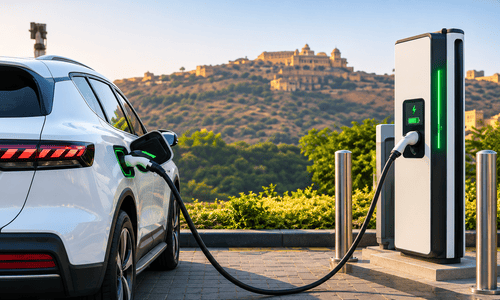
The platform is designed to solve a problem many EV owners know well: different charging networks, different apps, different payment methods. Bharat e-Charge lets users find, access and pay for charging across participating networks through a single interface.
According to Qureshi, around 12 charging network operators have already joined. He also said most manufacturers of electric two-wheelers, three-wheelers and four-wheelers have been integrated into the system.
The platform was developed jointly by NPCI BHIM Services Ltd and Bharat Heavy Electricals Ltd (BHEL). The Ministry of Heavy Industries first outlined it in May as a way for EV users to locate and pay for charging across multiple operators.
Pilot in five states, expansion “as the network becomes more robust”
At present, the platform is available for pilot testing in five states. Qureshi was clear that the next phase depends on how the network performs.
“We have made it available for pilot testing in five states. As the network becomes more robust, we will keep expanding it,” he said.
He did not give a timeline for widening the pilot, and he did not say which states would come next. For now, the commitment is a direction rather than a date.
Highway charging remains a priority
Asked about charging along national highways, Qureshi said it continues to be a priority. The government has identified 24 freight corridors and about 50 corridors for cars as priorities for electrification.
Reliable highway charging matters because long-distance travel is where range worries are most visible. A single app that works across operators could, in principle, make that easier, though that depends on how many highway operators join and how the pilot performs.
Setting up a charging station needs no licence
Qureshi also addressed the business side. Private operators, he said, do not need a licence to set up charging stations.
“Establishing a charging station is an unlicensed business. So, anybody can establish it,” he said. He added that operators were already installing stations without government support.
What this means for EV owners and operators?
For EV owners, the main promise is convenience: one interface for discovering, accessing and paying for charging, instead of juggling several apps. For charging operators, joining a shared platform could mean wider visibility among EV users, as the pilot grows. These are reasonable readings of the stated design of the platform, not claims made by the ministry about usage or results.
The caution is worth stating plainly. The pilot covers five states, about 12 operators have joined, and no expansion date has been announced. Users outside the pilot states should not expect access soon.
FAQ
What is the Unified Bharat e-Charge platform?
- It is a platform that lets EV users find, access and pay for charging across participating charging networks through a single interface.
Who developed the Bharat e-Charge platform?
- NPCI BHIM Services Ltd and Bharat Heavy Electricals Ltd (BHEL) developed it together, according to Hanif Qureshi of the Ministry of Heavy Industries.
How many states is the platform available in?
- It is currently available for pilot testing in five states. The government says it will expand as the network becomes more robust, but has given no timeline.
How many charging operators have joined?
- About 12 charging network operators have joined, according to the official.
Is a licence needed to set up an EV charging station in India?
- According to Qureshi, establishing a charging station is an unlicensed business, so anyone can set one up.
Which highway corridors are being prioritised for EV charging?
- The government has identified 24 freight corridors and about 50 corridors for cars as priorities for electrification.