




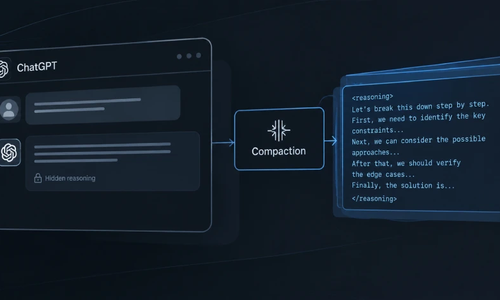
A feature built to save space in long AI conversations could be turned into a way to copy a model’s hidden reasoning out in readable form, according to research from the security firm Xint. OpenAI confirmed the problem and fixed it on October 23, Xint said.
The finding matters because OpenAI goes out of its way to keep that reasoning private. It is also a demonstration rather than an attack seen in the wild.
Why hidden reasoning is protected?
OpenAI’s reasoning models work through a problem before they give an answer. Through the API, users normally get back only an encrypted item that holds that raw reasoning, and they cannot read it.
One reason for keeping it hidden is to prevent distillation, where one company trains a cheaper model on another’s outputs. Raw reasoning makes better training data than a final answer alone, because it shows how the model worked through the problem. That is what makes it valuable to a rival.
What compaction does?
Compaction is an OpenAI feature that uses a model to squeeze a long conversation into a smaller, encrypted item. That item carries the context forward, so a long chat can continue without using up as much space.
Xint’s research shows that this same step could be pushed into doing something it was never meant to do.
How Xint says the technique worked?
Xint described the method in broad terms. It sent a task to gpt-5.6-sol, one of OpenAI’s reasoning models, and kept the encrypted reasoning the model returned. It then called the compaction step on the same model and told it to copy that reasoning into the compacted item word for word. Xint also made a small change to the text formatting to get past OpenAI’s usage-policy filters.
Because compaction items can move between models, Xint then passed the item to two cheaper models, gpt-4.1 and gpt-4o, and asked each to repeat its input exactly. Both did, and the hidden reasoning came out as plain text.
Why it got past an earlier fix?
This was not the first time researchers had tried to extract hidden reasoning. In August, a paper called “Stolen Thoughts” showed that encrypted reasoning from a strong model could be replayed into a weaker model from the same company, which would then repeat it as plain text. OpenAI and others blocked that kind of cross-model replay soon afterward.
According to Xint, compaction got around that block because the compaction step runs on the same model that produced the reasoning. That means it never triggers the cross-model check.
The idea also built on Xint’s earlier work, called GhostCompact, which showed the compaction step can be pushed to run tasks of an attacker’s choosing. Xint has published the code in its GitHub repository.
What the research does not show?
Xint was careful about the limits of its findings, and they are worth stating clearly.
- Scope: Xint ran the technique on gpt-5.6-sol using math and algorithm puzzles its own researchers wrote. The reasoning it extracted came from those same requests. Xint did not claim the method could reach another user’s reasoning.
- Accuracy: Xint says it cannot prove the copied text is word for word the model’s real reasoning, because it never had the original to compare against. Two cheaper models each repeated the item and produced the same text. That rules out copying mistakes, but it leaves open the possibility that compaction reworded the text.
- Other models: Xint tested only gpt-5.6-sol. It did not check whether GPT-6 Astra, OpenAI’s newer model, is affected.
- Real-world use: It is not known whether anyone used the method before OpenAI closed it.
The fix and what developers need to do?
The fix was made on OpenAI’s side, so developers who build on the API do not need to change anything. Xint called it an undisclosed fix and said OpenAI paid the researchers a $6,000 reward.
Xint also raised a broader worry. In its view, fixing this one path may not be enough, because any server-side step that reads a model’s decrypted reasoning and follows the user’s instructions could leak it.
The bigger picture
The research lands in a tense moment. OpenAI said in September that it had disrupted a July campaign that tried to expose its models’ hidden reasoning, and it linked a core part of that campaign to people associated with China’s Moonshot AI. Anthropic and a joint US government advisory have each reported China-based labs targeting the hidden reasoning of American models.
None of that is tied to Xint’s compaction method. Xint’s work is a research demonstration, not an incident reported in real use.
What to watch next?
Two questions remain open. The first is whether other model versions, including GPT-6 Astra, are affected, since Xint did not test them. The second is whether OpenAI and other AI companies change how server-side features handle decrypted reasoning, given Xint’s argument that a single patch may not close the whole class of problem.
Frequently Asked Questions
What did Xint find in OpenAI’s compaction feature?
- Xint showed that compaction, which shrinks a long conversation into a smaller encrypted item, could be used to copy a model’s hidden reasoning out as plain text.
Has OpenAI fixed the problem?
- Yes. According to Xint, OpenAI confirmed the problem and fixed it on October 23. The fix was on OpenAI’s side, so developers do not need to change anything.
Could someone read another user’s reasoning with this method?
- Xint did not claim that. It tested the method on its own puzzles and extracted reasoning from its own requests.
Is the extracted text the model’s exact reasoning?
- Xint says it cannot prove that, because it never had the original to compare against. Two cheaper models produced the same text, which rules out copying errors but not rewording by compaction.
Was this attack used in the real world?
- It is not known whether anyone used the method before OpenAI closed it. Xint describes its work as a demonstration, not an attack seen in the wild.
Why does OpenAI hide its models’ reasoning?
- Partly to stop distillation, where a rival trains a cheaper model on another company’s outputs. Raw reasoning makes better training data than a final answer alone.