


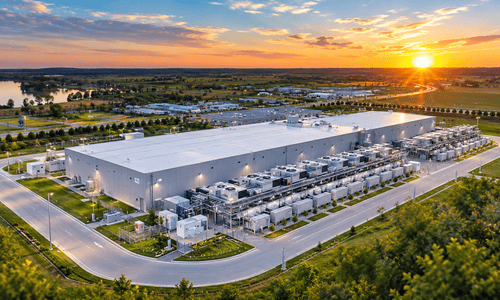
Early Sustainability Choices Could Unlock US$1 Trillion for Data Centres, WEF Report Finds
The data centre industry’s biggest constraint may not be power, water, or land — it may be timing.
That’s the central finding of a new report from the World Economic Forum (WEF), which argues that the resource tensions increasingly plaguing data centre development aren’t inevitable byproducts of scale. They’re the result of decisions made too late in the project lifecycle — and by the time developers realise it, the trade-offs are already locked in.
According to the report, getting siting, design, and procurement right from the very start of a project could unlock between US$700 billion and US$1 trillion in investment that is currently being lost to delays and outright cancellations.
The Problem Isn’t Scale — It’s Sequencing
Data centres today are under mounting pressure on three fronts: power availability, water access, and land use. As AI workloads push infrastructure demand to unprecedented levels, these constraints are becoming harder to ignore.
But the WEF report makes a pointed distinction — these aren’t fixed physical limits so much as they are the downstream consequences of choices made early, and often without enough foresight. Once a site is selected and a design is finalised, the report notes, the resource trade-offs baked into that decision become essentially permanent. There’s no retrofitting your way out of a location with strained grid capacity or a design that didn’t account for water scarcity five years down the line.
In other words, the industry doesn’t have a resource problem so much as a sequencing problem — and it’s showing up on balance sheets in the form of stalled projects and shelved investment.
Where the Trillion-Dollar Opportunity Comes From
The US$700 billion to US$1 trillion figure isn’t speculative upside — it represents capital that’s already being lost. Projects delayed by permitting disputes over water usage, cancelled after community pushback on power draw, or redesigned midway through construction because the original site couldn’t support long-term growth. These aren’t hypothetical scenarios; they’re increasingly common headlines in the data centre sector.
The report’s argument is straightforward: if sustainability and resilience planning happen before the shovel hits the ground — during siting, design, procurement, and financing — much of that lost capital could instead flow into successful, resilient projects.
Pim Valdre, Head of the Economic Agenda at the World Economic Forum’s Centre for Nature and Climate, frames it as a narrowing window rather than a permanent fix:
“Sustainability and resilience should be considered together from the outset of the data centre development process, during siting, design, procurement and financing. This is when many of the most consequential decisions are made that can affect operations through the entire lifecycle.”
Valdre’s point cuts to the heart of the report’s urgency. With AI infrastructure scaling at a pace few anticipated even two years ago, the industry is making long-lived, capital-intensive bets right now — bets that will define operational flexibility for decades.
“As AI infrastructure scales, we need to seize the opportunity now to ensure we are not left for decades with assets with high risk or low resilience,” Valdre added.
That’s a notable framing shift. This isn’t just an environmental argument — it’s a risk-management one. A data centre with locked-in resource constraints isn’t just less sustainable; it’s a less resilient, less adaptable asset for its investors and operators over its operational lifetime.
Why No Single Player Can Solve This Alone?
Perhaps the most practically important finding in the report is who it says can’t fix this problem on their own: developers, operators, investors, and policymakers — none of them, working in isolation, can course-correct an industry-wide pattern of late-stage sustainability planning.
That’s because each of these stakeholders enters the project timeline at a different stage, with different incentives and different visibility into the full picture. A developer optimising for speed-to-market may not be thinking about ten-year water availability. An investor evaluating returns may not have visibility into local grid constraints. A policymaker setting permitting rules may not understand the technical trade-offs a design team is navigating.
To address this misalignment, the WEF report lays out a decision framework built around six core principles — designed to give every stakeholder in the development chain a shared reference point from the earliest planning stages onward. Rather than treating sustainability as a compliance checkbox added late in the process, the framework pushes it into the same conversation as site selection, design architecture, procurement strategy, and financing structure — from day one.
What This Means for the Industry Going Forward?
For an industry racing to keep pace with AI-driven demand, the WEF’s findings land as both a warning and an opportunity. The warning: continuing to treat sustainability as an afterthought risks locking billions of dollars into assets that carry outsized operational and reputational risk for decades. The opportunity: getting the sequencing right — early, aligned, and collective — could be the difference between a stalled project and a resilient trillion-dollar pipeline of investment.
As AI infrastructure buildout accelerates globally, the report’s message is clear: the industry doesn’t need to choose between speed and sustainability. It needs to stop treating them as sequential decisions and start treating them as one.