




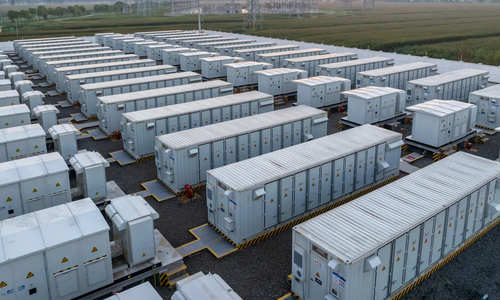
Exelon’s utilities could spend $3 billion to $7 billion building 1.5 GW to 3.5 GW of regulated energy storage. That range does not include a $1 billion, 500-MW project already proposed in New Jersey. Counting that project, the potential spending reaches about $8 billion.
Chief Financial Officer Robert Kleczynski explained why the company favours the regulated model: “With regulated storage, we have certainty that projects get built, and control over when and how they’re deployed.” He was careful to add that utility-owned storage is meant to sit alongside competitive development, not replace it: “We view utility-owned storage as one option alongside competitive development, not a replacement for it.”
He said customers would benefit in two ways: lower capacity prices, and the flow-through of investment tax credits, which would soften the effect of the new assets on electricity rates.
Three states where Exelon utilities operate, New Jersey, Maryland and Delaware, allow utilities to own storage facilities to strengthen grid resiliency.
The New Jersey Project
The 500-MW project from Atlantic City Electric, developed with Invenergy, would be the largest battery installation in the PJM Interconnection. Kleczynski said it is expected to provide more than $700 million in net benefits to customers. Exelon expects the New Jersey Board of Public Utilities to decide on the proposal late in the first quarter of next year. You can follow the case summary on the BPU site.
Why Exelon Says PJM Is the Problem?
According to President and CEO Calvin Butler, PJM is not moving fast enough to add generation to its system. He called this the biggest issue facing consumers across the grid operator’s Mid-Atlantic and Midwest footprint.
Two key PJM initiatives have been held up because the Federal Energy Regulatory Commission approved them only in part: its backstop capacity procurement plan and its Interim Resource Adequacy Service proposal. Butler said: “Neither proposal would have solved the reliability and affordability challenges facing our customers, but both represented important steps forward.”
His view is that adding storage and transmission can help fill the gap.
Transmission Spending
Exelon’s current capital plan calls for $16.3 billion of transmission investment through 2029. The company also sees room for another $12 billion to $17 billion beyond that plan, including infrastructure for large loads.
Large Loads: Steady Now, Smaller Pipeline
Exelon’s “high-probability” large load additions held flat at 11 GW from last quarter:
- 9 GW in Commonwealth Edison’s (ComEd) service area in northern Illinois
- 2 GW in the Mid-Atlantic region
The longer-term pipeline slipped to 23 GW from 25 GW last quarter, made up of 14 GW at ComEd and 9 GW in the Mid-Atlantic.
Q3 2026 at a Glance
| Item | Figure |
|---|---|
| Potential regulated storage spending (including the 500-MW New Jersey project) | $8B |
| High-probability large load additions | 11 GW (unchanged from last quarter) |
| Year-to-date adjusted operating earnings | $2.20 per share, up 1% year-on-year |
Full numbers are in Exelon’s Q3 2026 presentation.
What to Watch?
Two things will show how far this plan can go: the New Jersey regulator’s decision in early 2027, and whether PJM can speed up the addition of new generation. Until supply catches up, storage and transmission remain Exelon’s main answer to tight capacity.