


Wood Mackenzie: Four-Hour Batteries Now Beat Gas on Cost
Key points
- Four-hour battery storage is now cheaper than open-cycle gas turbines in all 43 markets where Wood Mackenzie modelled both technologies.
- In the Middle East and Africa, storage costs are expected to fall another 33% to USD 80 per MWh by 2035.
- Solar with single-axis trackers is the cheapest new-build option in 43 of 48 markets modelled.
For years, the standard answer to a simple question has been that gas plants are what you build when the grid needs power for a few hours at the end of the day. That answer is now being challenged by the numbers. According to Wood Mackenzie’s latest global report on the levelised cost of electricity (LCOE), unveiled on Thursday, four-hour battery storage is cheaper than open-cycle gas turbines in every one of the 43 markets where the consultancy modelled both technologies.
It is a sweeping result, and one worth reading carefully. Here is what the report says, what the figures mean and where their limits lie.
What the report found?
The headline finding is about breadth rather than a single market. Wood Mackenzie did not find that batteries beat gas in a handful of favourable locations. In all 43 markets where it modelled both technologies, four-hour storage came out cheaper than open-cycle gas turbines, the kind of plant typically used to cover short peaks in demand.
The same report looked at generation as well. Solar power using single-axis trackers is the cheapest new-build technology in 43 of the 48 markets modelled. Onshore wind is the lowest-cost option in the remaining five. Together, the two findings sketch a power system in which new solar and wind supply the energy, and batteries increasingly supply the flexibility that gas once did.
The Middle East and Africa: a clear lead
The report singles out the Middle East and Africa for particular attention. Four-hour storage there is expected to decline by another 33%, to USD 80 (EUR 71) per MWh by 2035. At that level it would beat gas peaking on cost in every gas market in the region.
That matters because many of these markets have long relied on gas for peak capacity, and several have strong solar resources that leave the grid with a daytime surplus and an evening gap. Storage is the obvious tool for moving one to the other. The report suggests it is also becoming the cheapest one.
China sets the benchmark for the rest of Asia Pacific
China has the lowest grid-scale storage costs in the world, according to the report. Its LCOE is more than 55% below the average for the rest of Asia Pacific, which stands at USD 134 per MWh.
The gap is expected to narrow. Wood Mackenzie expects the rest-of-region average to fall to USD 92 per MWh by 2036, and it points to competitive Chinese supply as the driver. In plain terms, markets outside China are expected to benefit from the manufacturing scale and price competition that Chinese suppliers have built up, rather than having to reach those cost levels on their own.
Why the economics are shifting?
Ahmed Jameel Abdullah, principal analyst at Wood Mackenzie, summarised the dynamic in one sentence: “Gas turbine shortages and rising fuel volatility are driving up peaking costs, while expanding battery manufacturing continues to push storage costs down.”
The statement describes two forces moving in opposite directions. On one side, gas peaking is becoming more expensive because turbines are in short supply and fuel prices are less predictable. On the other, battery manufacturing keeps expanding, which keeps pulling storage costs lower. The crossover the report describes is what happens when those two lines meet.
It is worth noting that the argument is not only about the price of a battery. Fuel volatility is a cost that sits entirely on the gas side. A battery has no fuel bill, so its cost is largely fixed once it is built. For a utility or a government planning years ahead, that predictability has its own value, even though it is hard to capture in a single headline number.
Solar leads on new-build cost
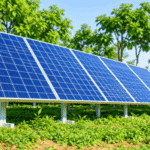
The generation findings are just as striking. Solar with single-axis trackers is the cheapest new-build technology in 43 of the 48 markets studied, and onshore wind takes the remaining five.
The most cost-effective markets are Saudi Arabia and the UAE. Wood Mackenzie expects solar LCOE in both to fall below USD 20 per MWh by 2033. Those are some of the lowest electricity costs the report anticipates anywhere, and they come from two countries better known for their oil and gas.
How to read LCOE figures?
LCOE is a standard way of comparing power technologies. It estimates the average cost of each unit of electricity over the life of a project, covering the cost of building, financing and running it. Because it reduces a complicated project to a single number, it makes comparisons easy.
That simplicity is also its limit. LCOE does not by itself describe how a technology behaves on a real grid, such as whether it can deliver at the moment demand peaks, how it affects other plants, or what the network costs to support it. A four-hour battery and an open-cycle gas turbine also do different jobs. The battery stores energy and releases it for up to four hours, while the turbine generates power for as long as it has fuel. The report’s comparison is therefore a measure of cost for a specific service, and it should be read as such.
Two further points matter for readers. These figures are modelled estimates, not observed prices from individual projects, and the 2033, 2035 and 2036 numbers are forecasts. Actual project costs will vary with local conditions, financing and supply chains.
What to watch next?
The report raises questions that will take time to answer. Will gas turbine shortages ease, and what would that do to peaking costs? Will battery prices keep falling at the pace Wood Mackenzie expects? And will the cost advantage in markets outside China narrow as the report projects, with competitive Chinese supply as the driver?
For now, the direction of travel is clear. In the 43 markets where it compared the two technologies, Wood Mackenzie finds that four-hour storage has moved ahead of gas peaking on cost, and the regions it highlights are expected to widen that lead over the coming decade.