



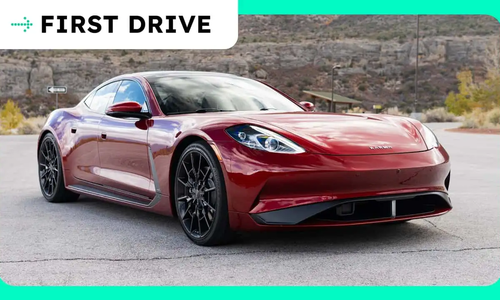
One thing needs clearing up first. Karma is not Fisker. Karma bought the assets of the original Fisker Automotive, the company that built the series-hybrid Fisker Karma and went bust in 2014. It has no connection to the recently collapsed Fisker Inc., which made the Ocean. Karma has instead spent the years since carrying that hybrid’s legacy forward, first with an updated version called the Revero, and now, 12 years into its life, with a genuinely new product: the Gyesera.
“New” is a generous word, though. This is a car built on an old platform, and the new car’s age shows in the places that matter most.
Disclosure: Karma flew the reviewer to Las Vegas, put him up at the Wynn for the first-drive event, and provided meals and test cars.
Old bones under a new skin
Take away the new front and rear styling and the elegant silhouette of the original Fisker Karma is still there. So are its packaging problems. The battery runs through a central tunnel and the roofline is low, which squeezes rear passengers into awkward positions. Inside, the bubbly steering wheel looks like it belongs to 2010, because its design does.
These are not careless choices. They follow from Karma’s situation. The company has limited cash and is still trying to reach mainstream awareness, so it could not afford to rework the crash structure or change safety-critical parts such as the steering wheel airbag. Within those limits, Karma has made real progress. The Gyesera is better looking than its predecessors, a better hybrid and a more luxurious car.
What the Gyesera actually is?
The Gyesera descends from what was arguably the first extended-range electric vehicle (EREV) sold in America, and the second plug-in hybrid after the Chevrolet Volt. Unlike the Volt, the original Fisker Karma had no way to connect its engine to the wheels. The engine worked only as a generator.
The Gyesera follows the same formula, but nearly every part of it is different:
| Fisker Karma | Gyesera | |
|---|---|---|
| Engine | GM-sourced 2.0-liter four-cylinder | BMW-sourced 1.5-liter three-cylinder |
| 0-60 mph | Over 6 seconds | 3.7 seconds |
| Electric-only range | 32 miles | 80 miles |
The extra range comes from a 28 kWh nickel-manganese-cobalt (NMC) battery in the central tunnel. It now supports fast charging at 50 kW, so it can be topped up in about 30 minutes.
Drivers choose between three modes using paddles behind the wheel:
- Stealth: pure electric driving
- Sustain: the engine runs to keep the battery topped up
- Sport: engine and motors work together for maximum output of 566 hp, with plenty of noise
That last mode shows how Karma’s thinking has changed. The original Fisker arrived when electric power was the exciting new thing. The Gyesera is aimed at a high-end market that is wary of pure EVs, so it leans into the combustion engine. The three-cylinder’s exhaust exits right beside the driver, which makes it sound extra loud.
Behind the wheel
Karma led journalists on a 200-mile route outside Las Vegas, through Red Rock Canyon and deep into the mountains. The day focused far more on fast, gas-burning driving than on quiet electric motoring.
Nothing about it was quiet. The reviewer’s strongest memory is of the raspy three-cylinder, always a beat or two behind what was happening on the road. Press the accelerator and the car surges forward at once, but the revs only climb half a second later. Lift off and the engine keeps singing for another moment.
The writer admits a bias, since three-cylinder engines are his least favorite sound, and the exhaust is very close to the driver’s ears. He is not against loud cars, and says he loves straight-sixes, V8s and naturally aspirated sports cars. But this sound had little charm, and because it does not follow the accelerator in real time, it adds nothing to the sense of engagement. By the end of the day it was deeply irritating.
It was irritating while standing still, too. Left running in Sport mode, the car buzzed away trying to recover the energy it had spent on a high-altitude climb. The reviewer noted that a supposedly electric car idled louder than his own 20-year-old V8 SUV.
Handling
Cornering did not win him over either. The car felt twitchy and hard to trust. It was often unsettled under braking, shimmying from side to side as it slowed. Both motors sit on the rear axle, with torque-vectoring software meant to help the car exit corners quickly. In real driving, the wheels often felt as if they were not working in harmony.
As a sports car, the Gyesera is hard to defend. It is slower than almost any gas or electric rival. It is less charming than any gas or hybrid car with an engine that drives the wheels, and too unrefined for EV fans. It also costs more than the BMW M5, Porsche Taycan, Lucid Air and the upcoming Jaguar Type 01, which hurts its case further.
The verdict
Designing a competitive car is hard and expensive. With limited time and money, it makes sense that Karma relies on the only platform it has.
But the result is too rough to recommend at $139,995. The Gyesera looks fantastic and offers plenty of electric range. By almost every other measure, subjective or objective, it trails its class. Karma markets it as an ultra-luxury product, yet the cabin feels cheaper than a mid-spec BMW 5 Series. It is meant to be a performance car, yet it is slower, less refined and less charming than its conventional rivals.
Karma’s executives point to what comes next, namely the upcoming Amaris and the long-delayed Kaveya EV, as the foundation of the company’s new era. After 12 years, though, time is running short to show it can do more than adjust a platform developed by someone else.
Why would anyone buy one?
The one argument from Karma that holds up is exclusivity. It was no accident that the first-drive event was tied to the Concours at Wynn Las Vegas, packed with Bugattis, Paganis and McLaren F1s. The buyer for a car like this is not meant to be cross-shopping it with Porsches. That buyer already owns Porsches, Rolls-Royces and plenty more, and may simply want one more car in the collection.
Frequently Asked Questions
Is Karma the same company as Fisker?
- No. Karma bought the assets of the original Fisker Automotive, which went bust in 2014. It is unrelated to Fisker Inc., the maker of the Ocean EV.
What is the Karma Gyesera?
- It is Karma’s first new model in a decade, a luxury extended-range hybrid sedan developed from the Fisker Karma and Karma Revero platform.
How much does the Gyesera cost?
- It is priced at $139,995.
How fast is the Gyesera and how far can it go on electricity?
- It reaches 60 mph in 3.7 seconds and can travel 80 miles before the engine starts. Peak output in Sport mode is 566 hp.
What powers the Gyesera?
- A BMW-sourced 1.5-liter three-cylinder engine and two rear-axle electric motors, with a 28 kWh NMC battery that supports 50 kW fast charging.
Is the Gyesera worth buying?
- The reviewer does not recommend it. He praises its looks and electric range but finds it slower, less refined and less well finished than rivals that cost less. Its main appeal is exclusivity.
What is Karma planning next?
- The company points to the upcoming Amaris and the long-delayed Kaveya EV as the foundation of its new era.