


The Renewable Energy India (REI) Expo and The Battery Show drew record energy-storage interest in Greater Noida. Conversations with exhibitors also pointed to real pressure points across solar, batteries and inverters.
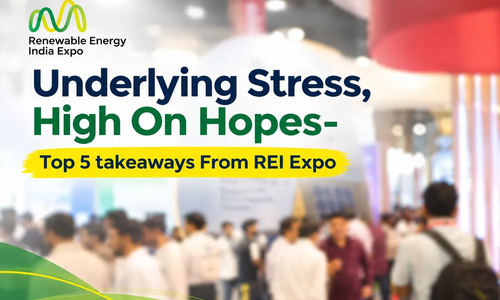
This year’s Renewable Energy India (REI) Expo, held alongside The Battery Show at the Expo Centre in Greater Noida, made one thing clear: India’s green energy sector has grown into a large, crowded and fast-moving industry. It also showed, just as clearly, that growth has brought stress to parts of the supply chain.
A bigger show, and a busier floor
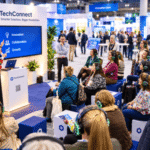
Exhibition space was fully taken, and companies of every size, from large groups to small firms, competed for attention. Branding was more aggressive than in earlier years, with some exhibitors taking over buildings near the venue to get their message across.
Footfall was strong, driven largely by interest in energy storage. That helped make this the biggest edition so far of The Battery Show in India.
The organisers, Informa Markets, also tried something new: paid entry for visitors registering on the spot. A fee of Rs 500 appears to have thinned out casual visitors after the first day, which gave the halls more breathing space on later days.
Chinese companies returned in strength, across solar manufacturing, battery energy storage system (BESS) manufacturing and components. For many on the floor, this was a sign that these firms remain keen to sell their technology, even as the government in Beijing is seen as more guarded about it.
The five takeaways below come from conversations with companies at the show.
1. Solar module makers are under stress as the DCR cell shift nears
Modules that are not made with domestic content requirement (DCR) cells are selling at zero or even negative margins. That puts non-integrated module assemblers, those without their own cell manufacturing, under severe financial pressure.
The market is due to move fully to DCR by January 1, 2027. Companies without in-house solar cell capacity will find it much harder to source cells effectively. A broad industry view at the show was that this will lead to significant consolidation by mid-2027.
2. BESS capacity plans may be running ahead of demand
At The Battery Show India, announcements of new BESS assembly capacity kept coming. Yet projections suggest demand may cover less than half of the capacity that has been planned.
There is a more encouraging side. Localisation is deepening upstream, beyond simple pack assembly. Participation is rising in cathode materials, electrolyte formulation and dry-electrode technology, which points to a more substantial supply chain taking shape.
3. The inverter “manufacturing boom” has a white-labelling reality
Indian companies showed a wide range of inverters. But industry insiders said much of this surge is driven by white-labelled Chinese imports, sold under local brands by companies chasing quick market share through incentives such as the PM Surya Ghar scheme.
India has no domestic content requirement for inverters. As a result, several insiders described the current activity as a short-term trading window and not the start of a sustained, decade-long manufacturing expansion.
4. Residential solar and storage are converging
Rooftop solar adoption is rising, and grid instability is a concern. In response, module and power electronics suppliers are bundling residential solar PV with integrated BESS units. Their aim is to capture margins across the whole system, through all-in-one solutions for homes as well as commercial and industrial users.
A major trigger could be the inclusion of storage in a refreshed version of PM Surya Ghar, along with other central schemes. Such a move would give the segment a strong push.
5. Green hydrogen and bioenergy are moving from concept to deployment
Exhibitors displayed megawatt-scale electrolyzers, compressed biogas (CBG) models, and transport and storage setups. This marks a shift from early planning toward commercial technology aimed at decarbonising heavy industry.
CBG in particular has progressed a great deal in the past 24 months. Developers now have functioning plants to showcase, and lessons from early adopters are helping shape the next phase.
What the show tells us?
Taken together, the five takeaways describe a sector that is expanding quickly but unevenly. Storage, green hydrogen and bioenergy are moving into real deployment. Meanwhile, solar module assembly, BESS assembly and inverters show signs of overcapacity, thin margins or reliance on imports.
For investors, manufacturers and policymakers, the message is that headline growth does not guarantee profits for every player. The next 12 months, including the DCR deadline and any changes to the PM Surya Ghar scheme, are likely to separate companies with real depth from those riding a short-term opportunity.
Frequently Asked Questions
What is the REI Expo?
- The Renewable Energy India (REI) Expo is one of India’s largest renewable energy exhibitions. This year it was held alongside The Battery Show at the Expo Centre in Greater Noida and organised by Informa Markets.
What is the main stress point in solar manufacturing?
- Non-DCR modules are facing zero to negative margins. With the market moving fully to DCR by January 1, 2027, module makers without their own cell manufacturing are under severe pressure, and the industry expects consolidation by mid-2027.
Is India facing BESS overcapacity?
- Insiders at the show said announcements of BESS assembly capacity continue to rise, while demand is projected to cover less than 50% of planned capacity.
Why are there so many Indian inverter brands?
- Much of the inverter boom is driven by white-labelled Chinese imports aiming for quick market share through incentives such as the PM Surya Ghar scheme. As India has no domestic content requirement for inverters, many view it as a short-term trading window.
What progress has green hydrogen and bioenergy made?
- Exhibitors showed megawatt-scale electrolyzers and CBG models. CBG developers now have functioning plants to showcase after significant progress in the past 24 months.