



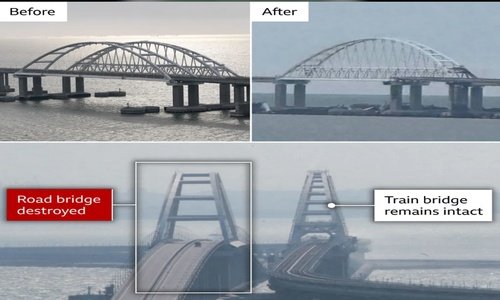
Ukraine has dealt one of its heaviest blows yet to the Crimean Bridge, the road and rail link that ties Russia to the occupied peninsula. President Volodymyr Zelensky described the strike as an “unprecedented operation” that took weeks to prepare. Images shared by Ukrainian officials show a large section of the bridge fallen into the water, a serious logistical and symbolic setback for Moscow.
The Kremlin has said it will rebuild the bridge “better than before.” Russia’s Investigative Committee has confirmed structural damage and opened a criminal case on terrorism charges, blaming “Ukraine’s armed formations.”
What Happened at the Bridge?
The overnight attack used cruise missiles and drones. The damage looks far worse than anything seen in earlier strikes on the crossing. Video footage appears to show a large arched section destroyed, with the remains of the support arch and road deck sticking out of the water.
Ukraine’s military says the roadway is now “out of action” and no vehicle can cross. The rail section, which runs parallel to the road, was also hit by drones. Images show its supporting arch still standing, though damaged, and Russia’s transport ministry later said some rail services had resumed.
A Seven-Stage Operation
According to Zelensky, the strike was the result of a seven-stage operation run by the military and security services. Ukrainian forces gradually took out air defence systems, radars, electronic warfare equipment and other designated targets on the way to the final objective. He said several types of Ukrainian drones, along with Flamingo and Neptune cruise missiles, were fired during what he called a “pivotal stage.”
Ukraine’s security service, the SBU, said it had “systematically suppressed enemy air defence systems” over the course of a month. It added that no Russian defence system can guarantee the safety of what it called illegal objects occupied by the invaders.
Why This Bridge Matters So Much?
Russia built the Crimean Bridge after it invaded and illegally annexed the peninsula in 2014. The $3.6 billion (£2.7 billion) structure is widely seen in both countries as Vladimir Putin’s personal pet project. His close friend, the tycoon Arkady Rotenberg, built it, and Putin himself opened it in May 2018 by driving a lorry across it.
For Ukrainians, the bridge is one of the most hated symbols of the occupation. It also has real military value, as a road and rail route for Russian soldiers heading to the front line. Ukraine has targeted it many times but has struggled to close it for good.
There is a wider strategy here too. By hitting oil refineries and fuel depots, Kyiv has been trying to raise the economic cost of the war for Russia. Striking the bridge raises the political cost for Putin himself.
The timing adds to that. The attack comes just ahead of Putin’s planned meeting with the leaders of China and the US in Shenzhen on Thursday, and it could overshadow what he hoped would be a return to the spotlight. Zelensky had warned of major attacks in the days leading up to that meeting.
Reaction in Kyiv
In Kyiv, the mood was a mix of celebration and worry. Andrii, an engineer living in the city, told us, “We’re drinking champagne!” He said the strike would “deal a very heavy blow to the morale of the Russians.”
Some Ukrainians fear Putin may respond with more attacks on civilian infrastructure. Andrii was not convinced that could get much worse. “I don’t think the Russians can make things much worse; they’re already pounding us every single night with everything they’ve got,” he said.
That fear is not abstract. Loud explosions were heard in Kyiv just before midnight on Monday, and Mayor Vitaliy Klitschko reported “damage to critical infrastructure systems,” with heating and water supplies disrupted. Zelensky said four ballistic missiles were aimed at the Southern Bridge and three more at the Northern Bridge. Some above-ground metro services were damaged as well, after civilians were told to go to shelters.
By Tuesday, Klitschko said traffic had partly resumed on both the Pivnichnyi (Northern) and Pivdennyi (Southern) bridges over the Dnipro. That matters because eight major bridges connect the western and eastern parts of Kyiv, and an estimated three million residents depend on them every day.
Russia’s defence ministry, for its part, said it downed 2,256 Ukrainian drones. That is the largest Ukrainian drone attack since the war began, and the second day in a row a record was set.
What This Means for Russia’s Supply Lines?
The long-term effect is still unclear, but the risk of a serious transport and logistics crisis for the Russian military has gone up sharply. With the arched section down, the peninsula’s direct road and rail links to Russia are cut, at least until the crossing is repaired.
Russia still has options, but none of them is easy:
- The land corridor: A route still runs through occupied parts of Ukraine’s Zaporizhzhia and Kherson regions. However, Kyiv has been steadily striking transport routes across northern Crimea, as well as bridges and crossings around Chongar. This has already caused problems with fuel and other supplies, including military cargo.
- The Kerch Strait ferry: A ferry crossing could partly make up for the lost bridge, but its capacity is very limited and it is vulnerable to attack.
- Supply by sea: This is also risky, because Ukrainian naval and aerial drones operate widely in the area.
There is one more problem. Debris from the bridge, especially its huge arch, may have blocked the shipping channel. If so, larger vessels will find it harder to pass, which could create fresh trouble for Russian-occupied ports on the Sea of Azov, including Mariupol and Berdyansk.
Our Take
After years of covering this war, I would say the physical damage is only part of the story. Russia can repair or replace a bridge section, but it takes time, money and a secure working environment, and the area is under constant threat. The bigger shift is the message. A month-long campaign against air defences, followed by a strike this deep, shows Ukraine can plan and carry out complex operations against heavily protected targets. How Moscow answers, on the battlefield and in the diplomatic rooms of Shenzhen, will be worth watching closely.
Note: Many details of the operation come from Ukrainian officials and have not been independently verified. Russia has confirmed structural damage but has not accepted Ukraine’s account of events.
Frequently Asked Questions
Did the Crimean Bridge actually collapse?
- Part of it did. Images from Ukrainian officials show a large arched section of the road bridge fallen into the water, and Russia’s Investigative Committee has confirmed structural damage. The rail section’s arch is damaged but still standing.
Who carried out the attack?
- Ukraine. Zelensky said the military and security services ran a seven-stage operation, and the SBU said it spent a month suppressing Russian air defences beforehand.
What weapons were used?
- Zelensky said several types of drones were used, along with Ukraine’s Flamingo and Neptune cruise missiles.
Can vehicles still cross the bridge?
- No. Ukraine’s military says the roadway is out of action. Russia’s transport ministry says some rail services have resumed.
How has Russia responded?
- The Kremlin says it will rebuild the bridge “better than before.” Russia’s Investigative Committee has opened a criminal case on terrorism charges.
How will this affect Russian forces in Crimea?
- It raises the risk of fuel and supply shortages. Russia can still use a land corridor through southern Ukraine, a limited ferry crossing and sea routes, but all of them are exposed to Ukrainian strikes.
Why is the Crimean Bridge so important?
- It cost $3.6 billion, it was personally opened by Putin in 2018, and it is both a key supply route for Russian troops and a lasting symbol of the occupation.