




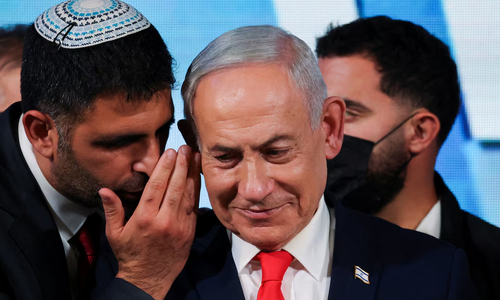
Exit polls show neither bloc near the 61 seats needed for a majority. Both leaders say they should lead, but neither has declared victory.
Israel woke up on Wednesday without a clear answer to the question its voters were asked on Tuesday: who should govern next? Exit polls left Prime Minister Benjamin Netanyahu’s bloc and the camp led by challenger Gadi Eisenkot level, and both leaders used their election-night speeches to set out why they should lead.
What the exit polls show?
Three television exit polls gave slightly different pictures. Kan 11 and Channel 13 had the two blocs tied at 51 seats each. Channel 12 gave Netanyahu’s Likud-led bloc a narrow 52-49 edge. Whichever poll is used, neither side comes close to the 61 seats needed for a majority in the 120-seat Knesset.
Exit polls are projections, not results. Final figures are expected on Thursday or Friday, and the numbers can shift as votes are counted. Yohanan Plesner, president of the Israel Democracy Institute, described the projections as a major setback for Netanyahu’s coalition. He also cautioned that Eisenkot had not emerged as a clear winner and that much could change during the count.
Two very different election-night messages
Speaking to supporters at Likud headquarters in Jerusalem after 3 a.m., Netanyahu called for “a strong, right-wing national government.” He pointed to Israel’s military record and spoke of a chance to act again with US President Donald Trump against Iran, while warning that outside motives should not distract from that goal.
Eisenkot, a former army chief who leads the Yashar party, took the opposite line. He said voters had turned against Netanyahu remaining in office and urged him to step away from politics. He described Netanyahu as a caretaker leader without a mandate, asked the security establishment to hold firm against any attempt to put politics ahead of national security, and warned Netanyahu not to use security for political ends.
Why a deadlock may still favour the incumbent?
The projections would be a clear step back for the 77-year-old prime minister, whose right-wing bloc once held 68 seats. Yet a stalemate does not remove him from power. If coalition talks drag on, or if the country heads to another election, Netanyahu could stay on as caretaker prime minister in the meantime.
Far-right religious parties led by Itamar Ben-Gvir and Bezalel Smotrich were projected to win a combined 13 seats within his bloc, with no major gains for either.
The kingmaker question
With both main blocs short of a majority, smaller parties could decide the outcome. Arab parties sitting outside the two main camps may hold the balance of power. Eisenkot, however, has all but ruled out forming a government with them, which complicates his own route to a majority.
Supporters of the Joint List, an alliance of Arab parties, cheered when the exit polls came out at their headquarters in Nazareth. Turnout among Palestinian citizens of Israel was described as historic, and candidates hoped it would be enough to block Netanyahu’s coalition from returning. One candidate, Faten Gattas, said her community rejects occupation and racism and will remain in the country.
Turnout overall was 77.7%, according to Israel’s Central Elections Committee. That is the highest in more than two decades and about seven percentage points above the 2022 figure. Eisenkot has said he would oppose another election given how many people voted. The Israeli shekel weakened modestly on the inconclusive result.
Who the candidates are?
Netanyahu has been prime minister for nearly 19 of the past 30 years and has survived repeated political crises. Opponents have removed him from the post only once since 2009, after four inconclusive elections in two years, and he returned 18 months later. He entered this campaign facing long-running corruption charges, which he denies, and criticism over the intelligence failures that preceded the 2023 Hamas-led attack. He has argued that he made Israel and the world safer by killing senior leaders of Hamas, Hezbollah and Iran.
Eisenkot, 66, entered politics four years ago. He joined Netanyahu’s war cabinet after the October 2023 attack but left eight months later, criticising the prime minister’s leadership. He lost a son and two nephews in the Gaza war. Domestically he presents himself as a centrist, but on security he has not broken with the hawkish line: he opposes Palestinian statehood and says Hamas’s military wing must be destroyed or dismantled. He argues that Israel’s response to the attack has failed because Hamas remains in control of Gaza. Gaza’s health authorities say the war has killed more than 74,000 Palestinians.
A vote shaped by war
This was the first national election since the October 7, 2023 attack, when Hamas killed 1,200 people and took 251 hostages, and since the wars in Gaza, Lebanon and Iran that followed. Voters were weighing that trauma, Netanyahu’s security record, and policies that have divided the country at home and deepened Israel’s isolation abroad.
What happens next?
Once final results are in, Israel’s fragmented system usually means coalition talks that last weeks or months. If neither bloc can assemble a government, the country may have to vote again.
Frequently asked questions
When was the election held?
- Tuesday, 27 October 2026.
Who won?
- No one has been declared a winner. Exit polls show both blocs short of the 61 seats needed, and neither Netanyahu nor Eisenkot claimed victory.
What do the exit polls say?
- Kan 11 and Channel 13 put the blocs at 51 seats each. Channel 12 gave Netanyahu’s bloc a 52-49 lead.
What was voter turnout?
- 77.7%, the highest in more than two decades, according to Israel’s Central Elections Committee.
When will final results come?
- They are expected on Thursday or Friday.
Can Netanyahu stay in office?
- Yes, as caretaker prime minister, during coalition talks or until a new election if one is needed.
Who could decide the outcome?
- Smaller parties, including Arab parties outside the two main blocs, could hold the balance of power.