


Germany Begins Trial of Ukrainian Suspect Over Nord Stream Pipeline Sabotage
Four years after the Nord Stream explosions shook European security, a German court in Hamburg opens the first criminal trial over the attack today. The defendant is a Ukrainian man, identified by prosecutors as Serhii K, who is accused of helping destroy the Russian gas pipelines running under the Baltic Sea.
What Prosecutors Allege?
German federal prosecutors say Serhii K, named in court documents as Serhii Kuznetsov, was a serving officer in the Ukrainian army in 2022. They allege he led a small team made up of professional divers, a boat captain and an explosives specialist. According to the indictment, the group planned the operation to cut off the gas revenue Russia relied on to fund its war.
He denies the charges. A second suspect, Volodymyr Zhuravlov, also denies involvement and is fighting extradition from Croatia.
The Attack and the Early Suspicion
The blasts hit on 26 September 2022, near the Danish island of Bornholm, and destroyed three of the four pipelines across the two Nord Stream systems. The invasion of Ukraine was then seven months old.
The damage did not take away any gas supply Europe was still receiving. Russia had already stopped Nord Stream 1 flows to Germany weeks earlier, and Nord Stream 2 was never put into operation after Berlin froze the project just before the invasion. Even so, the sabotage raised serious questions about the security of undersea infrastructure.
In the early months, Western governments pointed towards Moscow without formally assigning blame, and there were reports of unusual Russian naval activity before the explosions. Vladimir Putin, for his part, blamed the United States and the UK, a claim both countries rejected.
How the Investigation Reached Hamburg?
Sweden and Denmark eventually closed their own investigations. German prosecutors carried on and concentrated on a group of divers who had rented a yacht called the Andromeda in the northern port of Rostock. Investigators later said that samples taken from the boat showed traces of underwater explosives.
Germany’s Federal Court of Justice ruled that German courts have jurisdiction over the case, reasoning that the attack undermined the country’s internal security. Prosecutors are also treating it as a war crime under Germany’s code of crimes against international law, as an attack by military means on civilian objects. They allege the saboteurs acted on the orders of Ukrainian state agencies.
President Volodymyr Zelensky has consistently said Ukraine had nothing to do with the blasts.
Arrest and Extradition
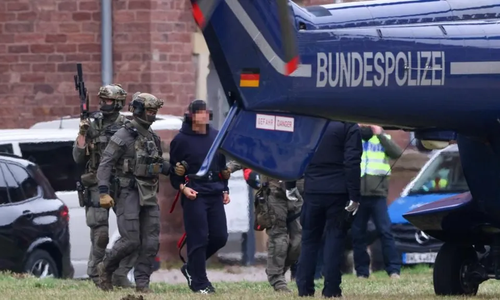
Serhii K was arrested in August 2025 at a hotel near the Italian resort of Rimini, under a European arrest warrant issued by German federal prosecutors. After several weeks of legal challenges in Italy, he was handed over to Germany late last year. He is the first person to stand trial over the attack.
The second suspect’s case has gone differently. A Polish court in Warsaw refused Germany’s extradition request for Zhuravlov in October 2025, with the judge describing any Ukrainian-organised armed operation as “justified, rational and just.” He was arrested again in Croatia in August on suspicion of taking part in the dives needed for the sabotage. Croatia approved his extradition last month, but the timing is unclear, and so is whether his case could join the Hamburg proceedings.
Kyiv and Berlin See It Differently
Oleksandr Merezhko, who chairs the Foreign Affairs Committee in Ukraine’s parliament, told the BBC that Nord Stream 2 was a tool Russia used to prepare for war. He added that Kyiv has no confirmation of the German account and called it “one of the versions.”
Stefan Meister of the German Council on Foreign Relations sees Berlin’s approach as deliberate. In his view, successive German chancellors have tried to keep the matter away from politics by leaving it to the judiciary and avoiding public attention.
Merezhko does not expect the trial to damage ties between the two countries, arguing it is in Germany’s best national interest to keep supporting Ukraine.
Why This Trial Matters?
Germany is one of Ukraine’s closest allies, so this is a sensitive test for both governments. The court will have to deal with the question of who ordered the attack, and also with the legal status of an act of sabotage committed during wartime. Whatever the verdict, it is likely to shape how European courts handle attacks on critical infrastructure in the future.