


Washington has ordered non-emergency government staff and their families out of the kingdom after drone and missile strikes killed three people and hit airports and energy sites.
The US State Department has ordered some of its diplomats and their families to leave Saudi Arabia, as attacks by Yemen’s Houthi movement on the kingdom grow more frequent and more deadly. Three people were killed in strikes across the country in the latest round of violence, according to Saudi officials.
What the State Department Said?
The order applies to non-emergency US government employees and their family members. A State Department spokesperson confirmed the move in a statement.
“The US Department of State issued an ordered departure for non-emergency US government employees and their family members in Saudi Arabia,” the spokesperson said.
The statement was blunt about the reason. “Iranian-supported Houthis have increasingly engaged in hostilities against Saudi Arabia, including attacks on civilian airports and other critical infrastructure resulting in civilian casualties and severe travel disruptions,” it said. The spokesperson also warned that “the hostilities have the potential to escalate rapidly”.
Three Dead in the Latest Strikes
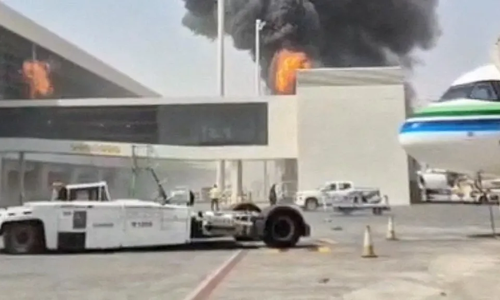
Saudi authorities said two people were killed by debris from a drone that was intercepted during an attempted attack on an oil field. One more person died after a strike on King Fahd International Airport in Dammam. Officials said eight people were injured in the airport attack, with injuries ranging from “minor to serious”.
Few details have been released. Authorities have not explained how the airport strike unfolded. The energy ministry has also not said who launched the drone aimed at the Shaybah oil field, which sits near the border with the United Arab Emirates.
The Dammam attack follows a pattern. Saudi airports have been targeted repeatedly by Houthi forces in recent weeks, and a recent strike on Riyadh’s international airport was the deadliest in the kingdom in years.
How the Conflict Reignited?
Tensions between the Houthis and Saudi Arabia have been climbing for about a month. The Houthis have answered Saudi strikes with missiles and drones aimed at airports, energy facilities and military bases inside the kingdom.
The roots go back more than a decade. Yemen has been devastated by civil war since 2014, when the Houthis ousted the government from the capital, Sanaa. The fighting deepened in 2015 after a Saudi-led military coalition stepped in to try to restore the government’s rule.
For the past four years, an informal ceasefire had largely held. It unravelled in July, when the Houthis announced a “maritime embargo” against Saudi Arabia and began missile and drone attacks on Saudi airports, oil facilities and tankers in the Red Sea.
The group says it is retaliating for what it calls a Saudi blockade of its territory, and for an air strike on Sanaa airport that it blames on the kingdom.
Why the World’s Oil Market Is Watching?
The fallout reaches well beyond the region. The Houthi embargo in the Bab al-Mandab Strait, along Yemen’s south-western coast, has contributed to a surge in global oil prices.
The timing makes it worse. Saudi Arabia had been leaning on the Red Sea for its oil exports since the US and Israel’s war with Iran effectively closed the Strait of Hormuz in the Gulf. With that route under pressure too, Riyadh has fewer safe options for moving its crude to market.
For now, the diplomatic order is a clear signal of how seriously Washington is reading the risk. As the State Department itself put it, the situation could change quickly.