



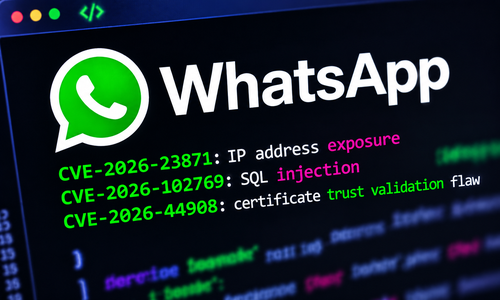
WhatsApp has fixed three security holes. The one that sounds the worst was actually found while the company was breaking up a scam that was happening at the time. The bug was in WhatsApp for Android and WhatsApp Business for Android. WhatsApp thinks a scammer was using it to make a scam message look more real.
The fix is out now. The advice is easy: update your app.
The Android bug tied to scam messages: CVE-2026-23871
The flaw, tracked as CVE-2026-23871, is in WhatsApp for Android and WhatsApp Business for Android in versions before 2.26.17.4. WhatsApp calls it validation of external ad-reply URLs.
In life, the risk was narrow. If an attacker sent a crafted Click to WhatsApp ad-reply message with media from a URL the attacker controls and that message showed up in a chat thread, the targets device could reveal its IP address to the attacker.
An IP address is not a password.. It can show roughly where a person is connecting from. In a scammers hands, that can help a fake message feel more personal and more believable.
WhatsApp said the issue may have been “abused in conjunction with spam messages.” The companys own security researchers found it. Reported it. A WhatsApp spokesperson said the hole came up while the company was disrupting a scam campaign. The spokesperson added: “We believe a scammer was using it to make their scam message seem credible.”
WhatsApp has not said how widely the bug was used or whether those scam tries worked.
The SQL injection flaw: CVE-2026-102769
The second issue, CVE-2026-102769, is an SQL injection hole in WhatsApp for Android before version 2.26.35.74.
It could be triggered when a recipient tapped a crafted “order details” message sent from an unofficial client. The result: files stored on the device could be deleted.
There is a more technical side to this bug. If the user was online when the malicious message came in, the flaw could also leak a bit of information through a timing-based side channel. WhatsApp said it “leaked one bit of information asked by the attacker about the users chat database via an induced-crash delivery receipt timing side channel.”
One bit is an amount of data.. It shows why researchers take side channels seriously. WhatsApp says there is no evidence this hole was exploited in the wild.
The Meta AI certificate flaw: CVE-2026-44908
The issue, CVE-2026-44908, is a trust-validation weakness in the certificate checking used for Meta AIs confidential computing setup (WhatsApp Private Processing). The affected versions are:
- WhatsApp for iOS before 2.26.24.72
- WhatsApp Business for iOS before 2.26.23.72
- WhatsApp for Mac Desktop before 2.26.23.72
- WhatsApp for Android before 2.26.23.74
WhatsApp Business for Android before 2.26.23.70
If someone exploited it, a bad actor placed inside Metas infrastructure could have gotten around the hardware root of trust. They would have used a Versioned Chip Endorsement Key (VCEK) certificate that was not signed by the hardware makers key. That is an demanding setup. That is why it matters mostly to people who study how secure AI processing gets verified.
WhatsApp also pointed to a safeguard. Any such certificate would first have to be published to the third-party binary transparency ledger used by WhatsApp Private Processing. According to the company, that ledger shows every published VCEK certificate chains to the hardware root of trust. WhatsApp says this confirms no exploitation happened.
What WhatsApp users should do?
WhatsApps guidance is to keep both apps and devices up to date. For people, that means:
Open the Google Play Store or Apple App Store and update WhatsApp or WhatsApp Business.
Update the WhatsApp app on Mac desktop too.
Be careful with ad-style or “order details” messages, especially from numbers you don’t know. Avoid tapping through on anything that feels off.
WhatsApp also thanked the bug bounty community for its help. The company said it keeps working on making its systems stronger.
Why this matters?
Scam messages rarely rely on one trick. A small technical flaw, like a URL that isn’t fully checked, can be enough to make a fake message look more real. This case is a reminder that the quickest protection for users is not a special setting. It is an one: install updates right away.
FAQ
What is CVE-2026-23871?
- It is a WhatsApp for Android hole involving validation of external ad-reply URLs. It could make a device reveal its IP address to an attacker when a crafted Click to WhatsApp ad-reply message was shown in a chat.
Was the WhatsApp hole used in scams?
- WhatsApp says it may have been abused alongside spam messages. A spokesperson said the company believes a scammer used it to make a scam message seem credible. The company has not shared how big those attempts were or whether they worked.
Which WhatsApp versions are affected by the Android IP-leak bug?
- WhatsApp for Android and WhatsApp Business for Android before version 2.26.17.4.
Do I need to update WhatsApp on iPhone?
- CVE-2026-44908, the certificate flaw, affects WhatsApp for iOS before 2.26.24.72 and WhatsApp Business for iOS before 2.26.23.72. Updating is the recommended step.
Has CVE-2026-102769 been exploited in the wild?
- WhatsApp says there is no evidence of exploitation.
What is the safest thing to do now?
- Update WhatsApp, WhatsApp Business and your device software.. Treat unexpected messages with care.